
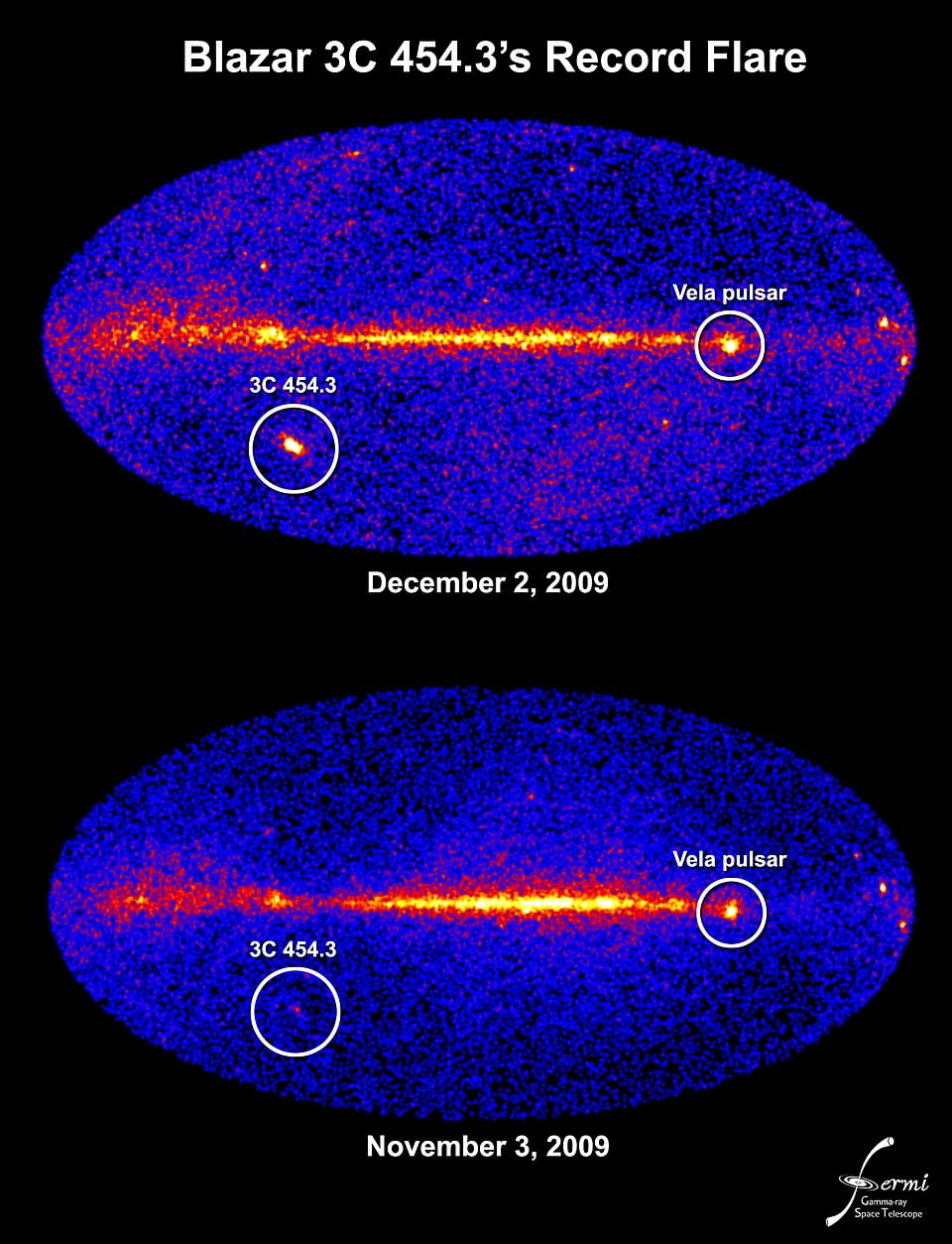
Gamma rays, the most high-energy type of electromagnetic radiation in the universe, have always had a blind spot. We’ve always had trouble measuring them in the “mega-electron volt” (MeV) energy range, which astronomers have taken to calling the “MeV gap”. But a new paper from an international group of scientists working with the Fermi Large Area Telescope (LAT) Collaboration recently published a paper in The Astrophysical Journal Supplement Series takes a stab at closing that gap by identifying 450 cosmic sources in the 20-200 MeV range, providing the clearest view of low-energy gamma rays ever.
The “gap” comes from a technological blind spot. Scientists have plenty of tools in the lower energy spectra, such as the Chandra X-ray observatory, that can capture radiation at the x-ray end of the electromagnetic spectrum, but high-energy gamma rays require entirely different detection methods. Gamma rays are notoriously difficult to capture because they pass straight through conventional telescope mirrors. Instead of reflecting light, spaceborne instruments like Fermi-LAT act more like orbiting particle detectors, tracking what happens when a gamma-ray photon strikes internal layers of tungsten and silicon.
Unveiling Distant Sources and Bridging the Gap
At high energies around 1 giga-electron volt, the impact leaves a distinct trace that allows scientists to point back to a source. However, in the lower energy range, photons scatter much more randomly. Compounded by intense background radiation from the Sun and distant galaxies, isolating individual sources required accumulated data and sophisticated mathematical analysis.
When the research team analyzed the data across 14 years of observations, they identified hundreds of cosmic sources in the 20-200 MeV range. The findings span both deep space and our own cosmic neighborhood, revealing details about distant quasars, active galactic nuclei, and spinning pulsars left behind by supernova explosions within the Milky Way.
Future Observations
Launched in 2008, the Fermi-LAT satellite continues to provide unprecedented insights, helping astronomers peer deeper into extreme cosmic accelerators. By bridging the elusive MeV gap, this comprehensive all-sky map paves the way for future space missions designed to target low-energy gamma rays, helping researchers finally illuminate one of astronomy's most persistent extreme-physics blind spots.
