
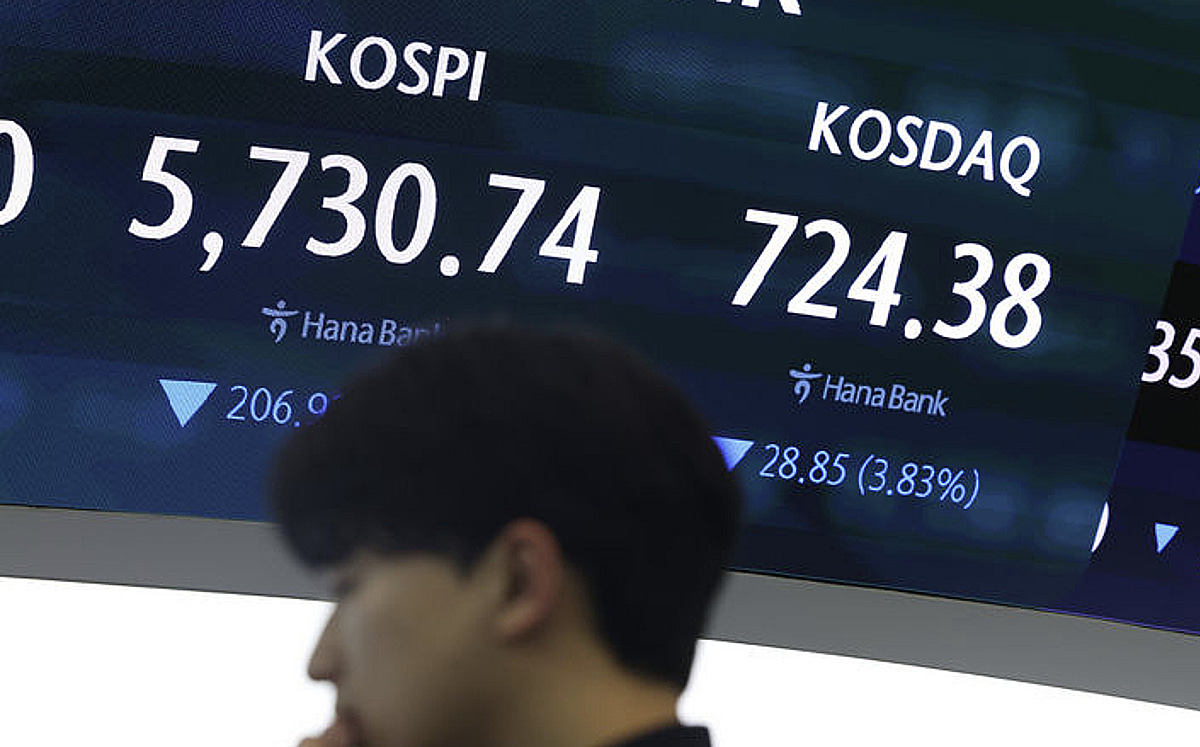
Both major South Korean stock markets experienced a sharp downturn as foreign investors pulled out of equities following disappointing tech earnings and growing doubts over the sustainability of artificial intelligence investments.
Market Sell-Off and Index Declines
The KOSPI plunged more than 3 percent on Friday, closing at 5,730.74, down 206.92 points or 3.48% from the previous trading day. The index opened at 5,760.35 and extended its losses throughout the session. The downward pressure was severe enough to trigger a selling sidecar when the KOSPI 200 futures index fell by more than 5%.
The KOSDAQ mirrored the weak performance, closing at 724.38, a decline of 28.85 points or 3.83%. It opened at 737.76 and remained subdued for the rest of the day.
Foreign Capital Outflows and Domestic Buying
Foreign investors led the exit across both major boards:
- KOSPI Market: Foreign investors offloaded 1.8254 trillion won worth of shares. Meanwhile, retail investors made net purchases of 871.3 billion won, and institutional investors bought 716.9 billion won on a net basis.
- KOSDAQ Market: Foreign investors and institutional investors net-sold 30.7 billion won and 136.1 billion won, respectively, while retail investors picked up 167.8 billion won in net purchases.
Semiconductor Sector Hit by AI Concerns
Domestic semiconductor shares faced heavy selling pressure after recent earnings reports from major U.S. tech companies sparked concerns over whether big tech firms can sustain heavy capital expenditures on AI through cash flows generated by their core operations.
Samsung Electronics dropped in the 3% range, while SK hynix tumbled in the 7% range. Affiliated and partner stocks also felt the impact: Samsung Electro-Mechanics fell in the 8% range, SK Square dropped in the 6% range, and Samsung C&T declined in the 3% range.
Valuation Pressure and Long-Term Outlook
While short-term volatility remains a concern, analysts suggest that the sharp correction has relieved valuation pressures on domestic stocks. Jo Ah-in, a researcher at Samsung Securities, noted that while the market's immediate direction depends on whether the correction is temporary or prompts downward earnings revisions, medium- to long-term investment appeal has improved.
Investors are advised to watch several upcoming market catalysts, including the implementation of the Korea Exchange's low PBR company disclosure system, the release of October import-export trends by the Ministry of Trade, Industry and Energy, the U.S. midterm elections, and upcoming earnings from global semiconductor firm AMD.
