
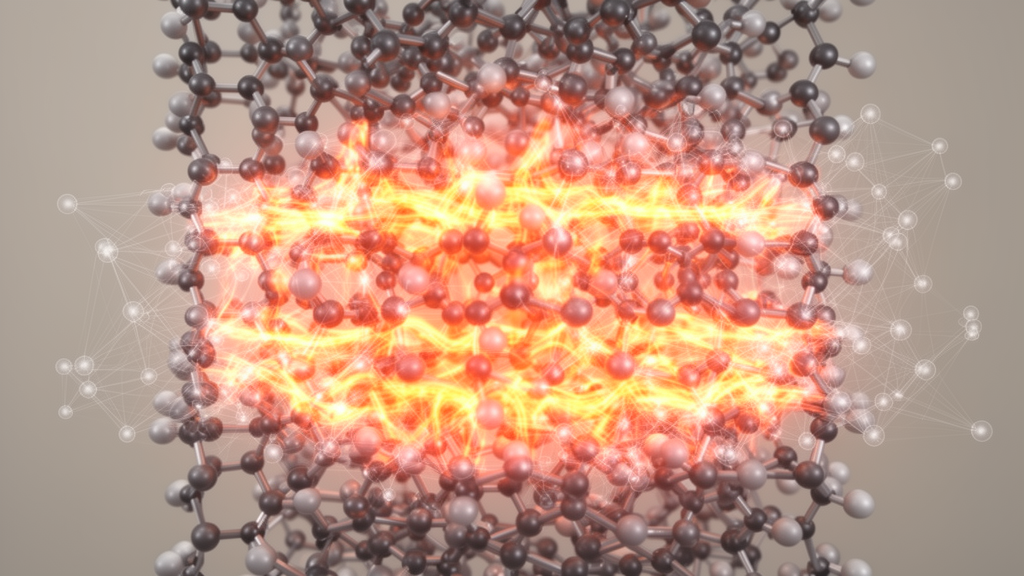
Computational materials physicists are deploying advanced artificial intelligence architectures to bypass conventional modeling bottlenecks and predict crystalline materials with unprecedented extremes of lattice thermal conductivity. Published in the Journal of Materials Science: Materials Theory, a new perspective details how multi-tiered machine learning pipelines are transforming the discovery of thermal materials for modern solid-state devices.
Historically, finding materials to manage or block heat depended heavily on empirical formulas like the Slack equation or labor-intensive density functional theory calculations. These traditional methods require solving the linearized Peierls–Boltzmann transport equation by computing interatomic force constants across multiple displaced supercells. Because a single thermal calculation can take up to 10,000 CPU hours, first-principles workflows have traditionally been limited to screening a few hundred compounds out of millions.
Overcoming Computational Bottlenecks With Multi-Tiered AI Pipelines
To break through this barrier, researchers established a comprehensive screening framework integrating universal machine learning interatomic potentials, crystal graph neural networks, and generative inverse-design models. Benchmarking evaluations across 2,429 crystalline materials showed that universal potentials calculate force constants orders of magnitude faster than standard methods. However, researchers discovered that low force error alone does not guarantee reliable phonon transport calculations; models must accurately capture the potential energy surface curvature that dictates higher-order anharmonic force constants.
Among the tested architectures, a fine-tuned EquiformerV2 model achieved a mean absolute error of 0.347 log(Wm−1 K−1) in predicting lattice thermal conductivity. This success stems from equivariant transformer operations that preserve geometric tensorial symmetries.
Direct Crystal Screening and Ultra-Low Thermal Insulation
Complementing potential-energy modeling, deep-learning frameworks evaluate crystal structures directly without requiring explicit atomic force evaluations. The Crystal Attention Graph Neural Network (CATGNN) incorporates electronic bonding descriptors—such as the negative integrated Crystal Orbital Hamilton Population (−ICOHP) and the Crystal Orbital Bond Index (ICOBI)—to quantify chemical bonding.
When applied across approximately 200,000 crystal candidates, CATGNN identified:
- 106 dynamically stable compounds with ultralow lattice thermal conductivities below 5 Wm−1 K−1 (with 68 percent falling below 2 Wm−1 K−1).
- 13 compounds exceeding 100 Wm−1 K−1.
Using an active-learning framework named Elemental-SDNNFF to screen 9,709 cubic double perovskites, researchers discovered an extraordinary outlier: the halide double perovskite Cs2HgPtCl6. It exhibits a predicted room-temperature lattice thermal conductivity of 0.071 Wm−1 K−1—comparable to the thermal conductivity of still air at roughly 0.025 Wm−1 K−1. Physical analyses revealed that asymmetric coordination around divalent mercury cations creates intrinsic quasi-rattlers that scatter acoustic phonon modes.
Tackling Boundaries and Future Milestones Toward 2030
At the opposite extreme, machine learning has helped identify metallic thermal conductors capable of surpassing conventional ceilings, while deep convolutional neural networks mapped out optimal substrate interfaces for heat dissipation in wide-bandgap semiconductors like gallium nitride and beta-gallium oxide.
Looking toward 2030, researchers have outlined key milestones for artificial intelligence in phonon engineering, including sub-hour comprehensive phonon property calculations, scalable models for electron–phonon interactions, and the realization of fully autonomous self-driving laboratories. By coordinating generative algorithms, robotic synthesis, and inline characterization, the scientific community aims to compress multi-year materials development cycles into rapid multi-day campaigns.
