
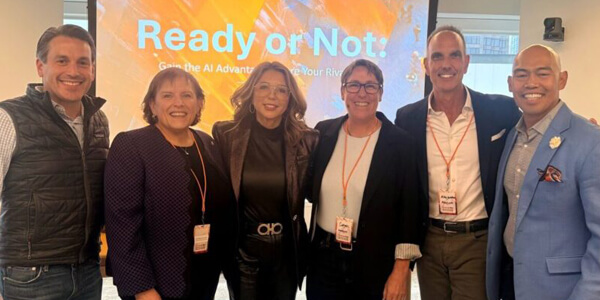
As artificial intelligence continues to reshape corporate operations and decision-making, academic leaders are actively contributing to industry conversations about workforce readiness. Recently, Northern Illinois University College of Business Dean Joan M. Phillips-Hernandez brought an academic perspective to a high-profile industry panel in Chicago.
The engagement highlights how business schools are collaborating with corporate leaders to understand technological shifts and align classroom preparation with evolving employer expectations.
Bringing the Higher Education Perspective to Corporate AI Discussions
Earlier this month, Dean Phillips-Hernandez participated as a panelist at the “Ready or Not: Gain the AI Advantage Before Your Rivals Do” conference. Hosted at the Chicago office of Armanino—one of the 20 largest independent accounting and business consulting firms in the United States—the event drew leaders from prominent organizations, including software company Coupa, financial planning platform Abacum, and financial services firm OneDigital.
The panel discussion focused on practical approaches to artificial intelligence, examining how organizations implement technology, where it generates tangible value, and how leaders can maintain a practical mindset. Representing higher education, Phillips-Hernandez bridged the gap between rapid technological adoption in industry and the fundamental responsibility business schools carry in preparing students for an AI-enabled workforce.
“I left even more convinced that curiosity must guide us as educators,” Phillips-Hernandez noted following the event, emphasizing the importance of exploring how technology alters commerce and providing students with meaningful classroom interactions with AI tools.
Integrating AI and Ethics Across the Business Curriculum
The insights gathered during the Armanino conference reinforced ongoing curriculum strategies at the NIU College of Business, where experiential AI learning and technical education are embedded across courses. Rather than viewing artificial intelligence as a replacement for human labor, faculty and administrators view the technology as a catalyst that changes the nature of work and employee responsibilities.
Instruction focuses heavily on how human judgment and technology interact, requiring students to develop a balance of technical competence, business acumen, and ethical awareness. Key educational priorities include:
- Learning to apply AI tools effectively, ethically, and strategically within business scenarios.
- Maintaining foundational business knowledge and soft skills necessary to evaluate automated results.
- Understanding how to collaborate in environments where human professionals work alongside AI agents.
- Retaining personal accountability for final business outcomes and decisions.
“Our responsibility is to prepare students to identify and understand business problems, collaborate to solve them and work effectively in a world where some of their colleagues may be AI agents,” Phillips-Hernandez stated.
Expanding Specialized Graduate Programs for Future Leaders
To meet the growing demand for professionals who can lead at the intersection of technology and commerce, the college has also expanded its specialized graduate education offerings. These programs are tailored to help students align modern data systems with broader organizational strategy:
- Master of Science in Business Analytics and AI: Focuses on advanced analytics, machine learning, practical AI applications, and data-driven business strategy.
- Master of Science in Artificial Intelligence for Business: Prepares learners to integrate information systems and intelligent automation to optimize organizational processes.
Beyond shaping curriculum, the dean's participation in the Chicago panel fostered meaningful connections with industry executives, opening potential pathways for future student opportunities and collaborations. By combining classroom instruction, faculty expertise, targeted degree programs, and employer partnerships, the NIU College of Business continues to ensure that academic institutions play an active role in defining the future of work.
