
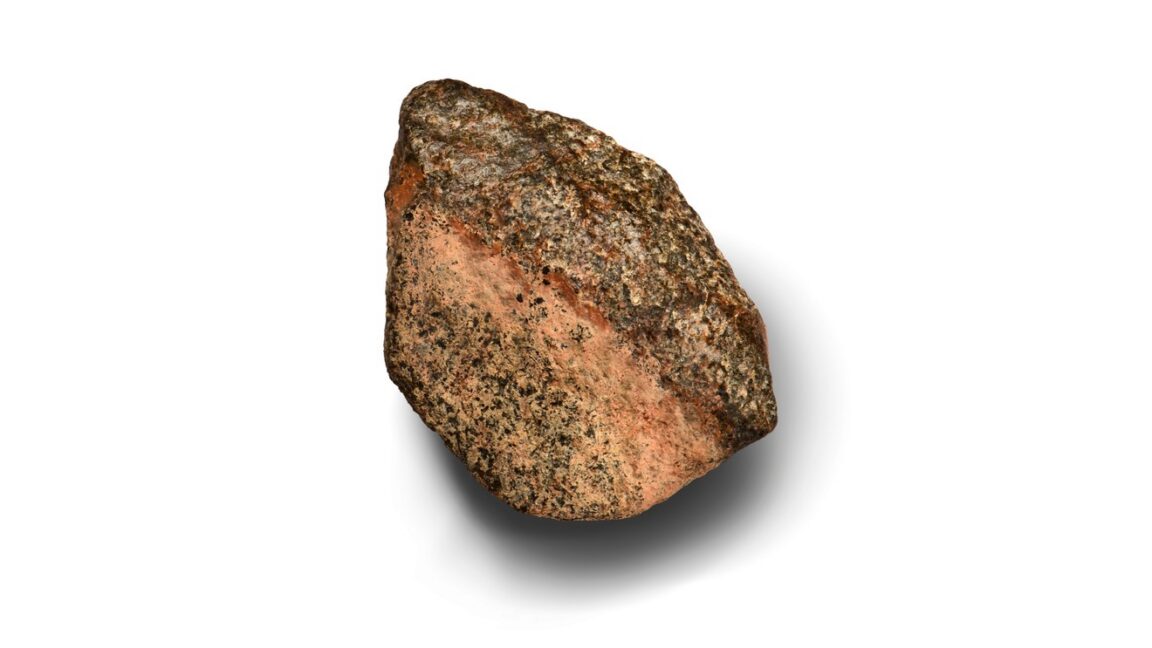
For decades, planetary scientists have relied on crater counting to estimate the age of the Martian surface, suggesting that the vast majority of the Red Planet is over 3 billion years old. However, the physical samples of Mars available on Earth have historically contradicted this timeline. Most Martian meteorites—categorized as shergottites, nakhlites, or chassignites—are relatively young, dating back 2.4 billion years or less.
Until recently, only two specimens provided a window into the planet's primordial history: the famous Allan Hills 84001 found in Antarctica and the fragmented "Black Beauty" meteorite from northwest Africa. A new discovery has now expanded this exclusive group, offering researchers a rare look at the ancient Martian crust.
A New Discovery in the Sahara
The meteorite, designated Teghaza 001, was recovered from the Sahara Desert in Mali in 2022. A research team led by Yang Liu, a planetary scientist at NASA's Jet Propulsion Laboratory, conducted an analysis of the rock to determine its origin and age. Their findings confirm that Teghaza 001 formed at least 4.1 billion years ago, placing it among the oldest Martian materials ever studied. According to Liu, the rock is remarkably ancient and shares characteristics with some of the oldest geological formations found on Earth.
The Physics of Planetary Ejection
The scarcity of ancient Martian rocks on Earth remains a subject of intense study. Scientists believe the process of transporting a rock from the Martian surface to Earth acts as a natural filter, significantly limiting the types of samples that survive the journey.
For a piece of Mars to reach our planet, it must be ejected by a high-energy impact event. This process involves several physical hurdles:
- Impact Dynamics: A massive impact is required to launch material with enough velocity to escape Mars' gravity.
- Structural Integrity: If an impact strikes loose, unconsolidated material, the debris may not be sufficiently cemented to survive the ejection process.
- Survival Bias: Weaker rocks are often pulverized during the impact, meaning only the most durable, well-cemented specimens are likely to make it into space and eventually land on Earth.
Implications for Martian History
The identification of Teghaza 001 provides a vital data point for understanding the early evolution of Mars. By studying rocks that date back to the planet's infancy, researchers can better reconstruct the geological conditions that existed billions of years ago. As scientists continue to analyze this rare specimen, it serves as a reminder that our understanding of the Red Planet is still heavily dependent on the rare, lucky arrivals of Martian debris that manage to survive the violent journey through the solar system.
