
When astronauts look down at Earth from the International Space Station at night, they encounter a landscape as dazzling as the stars above. While ground-based observers view the world from underneath atmospheric weather, orbital crews look down upon entire nighttime vistas, capturing phenomena ranging from sprawling metropolitan grids to intense oceanic activity and dynamic weather systems.
Among these orbital observations, atmospheric electrical activity holds a unique place in the memories of spacefarer photography. Former NASA astronaut Sally Ride once described how cloud cover diffuses electrical discharges into bursting spheres of illumination, creating the surreal impression of a transcontinental brigade tossing fireworks from cloud to cloud across massive storm systems.
A Nighttime Snapshot Over Southeast Asia
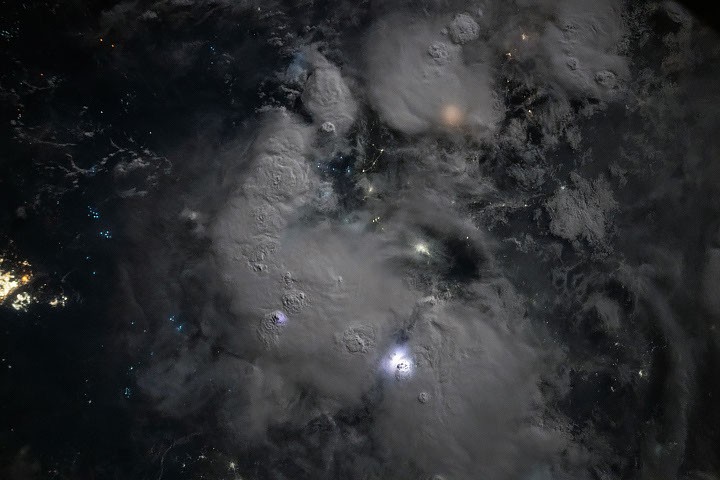
A striking orbital photograph captured by an Expedition 75 crew member on October 28, 2026, at 14:20 UTC showcases these overlapping earthly and atmospheric displays. Passing over the South China Sea near Borneo, the International Space Station's Nikon Z9 camera recorded a complex scene featuring:
- Urban Illumination: The bright lights of Singapore—home to 6.2 million people—anchoring the left side of the frame, separated from nearby Indonesian islands by the Singapore Strait.
- Maritime Activity: Clusters of blue lights west of Singapore produced by fishing vessels utilizing bright lamps to attract squid, sardines, and anchovies, alongside scattered orange points marking offshore gas flares.
- Severe Weather: Tall, domelike overshooting tops bubbling out of thunderstorms and reaching toward the stratosphere, fueled by strong updrafts and illuminated from within by electrical flashes.
The Global Scale of Atmospheric Lightning
For many crew members, capturing the constant dance of electrical storms remains a favorite aspect of documenting our home planet. NASA astronaut Anil Menon described lightning as resembling fireflies in the night, noting that real-time video footage helps convey the vast reach of storms across Earth's horizon.
Scientific estimates indicate that roughly 2,000 thunderstorms occur simultaneously across the globe at any given moment. These persistent meteorological systems generate nearly 60 individual flashes every second, translating to an astonishing 5 million lightning flashes across the planet each day.
Scientific Value of Crew Earth Observations
The image cataloged as ISS075-E-250951 was acquired using a 14-millimeter focal length and later processed by the ISS Crew Earth Observations Facility and the Earth Science and Remote Sensing Unit at NASA Johnson Space Center. Through the support of the International Space Station Program and the ISS National Lab, astronauts continue to photograph Earth to aid scientific research and provide freely available imagery to the public.
