
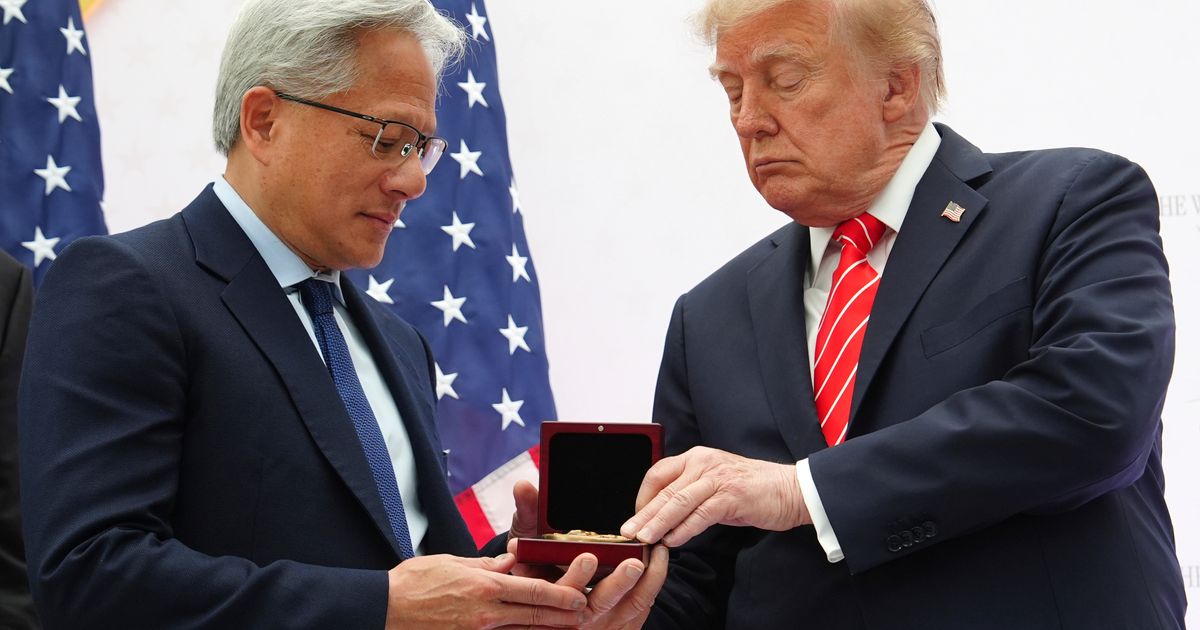
When Jensen Huang stepped down as chief executive of Nvidia in mid-November, the move sent shockwaves through financial markets and raised immediate questions about the stability of the company at the heart of the artificial intelligence boom. President Donald Trump, who has positioned AI as a cornerstone of his administration's economic agenda, viewed the leadership change as more than a corporate governance issue. With the United States competing fiercely with China for dominance in the sector, Trump believed that losing Huang—widely regarded as a singular talent in AI chip design—could jeopardize national interests if the executive were to be recruited by a foreign adversary.
Trump’s intervention began almost immediately after Huang’s resignation on November 12. The president, who has personal investments in Nvidia worth between $12.5 million and $58 million according to his 2026 financial disclosure, applied what he described as considerable sway to press for Huang’s return. In a CNBC interview following the reinstatement, Trump stated plainly that he had spoken to the company’s board and convinced them to reverse course. The board, which had previously insisted it was not considering such a move, ultimately agreed to restore Huang to his position.
Personal and Political Dimensions
The circumstances surrounding Huang’s ouster combined personal controversy with geopolitical concern. The Nvidia founder acknowledged relationships with women other than his wife, including one with Alice Huang, an executive at a Singapore-based company that U.S. officials suspected of being a Chinese intelligence asset. Beijing has denied any such connection. For Trump, the alleged espionage link added a layer of urgency. The president argued that Huang’s unique expertise in artificial intelligence made him irreplaceable, and that his potential departure—whether voluntary or otherwise—could benefit Beijing at a critical juncture in the AI race.
Trump was not alone in advocating for Huang’s return. Vice President JD Vance, Commerce Secretary Howard Lutnick, and Treasury Secretary Scott Bessent all weighed in, with Bessent recently calling for a “dramatic shake-up” at the company. The White House viewed Vance—given his Silicon Valley background—as an effective emissary to help persuade hesitant board members. Despite the controversy, Trump framed the episode as a necessary intervention to protect a technology sector he considers vital to American economic growth.
Market Reaction and Economic Stakes
The market response was swift and significant. Following Huang’s reinstatement on Monday, Nvidia shares opened 30% higher, and the S&P 500 jumped 4.7%. Trump has frequently cited stock market movements as a validator of his leadership, and the AI sector’s volatility has shaped decisions ranging from tariff policy to his administration’s approach toward Iran. The president has argued that the AI infrastructure build-out—projected to total $10.3 trillion from 2025 through 2032, according to Columbia University economist Stijn Van Nieuwerburgh—represents a massive economic driver. Nvidia’s semiconductors are central to that expansion, which has already enriched the wealthiest Americans, whose holdings comprise roughly 85% of U.S. stock wealth.
Critics, however, were quick to denounce the president’s role. Former House Speaker Newt Gingrich, a longtime Trump ally, wrote on X that there was “something profoundly wrong” about reinstalling a CEO ousted amid allegations of an improper relationship with a suspected spy. Senate Democratic leaders Chuck Schumer and Hakeem Jeffries also condemned the decision, with Jeffries calling it “indefensible, irresponsible and incomprehensible.” Senator Tim Scott, Republican of South Carolina, announced that Huang would testify before the Senate Banking Committee on December 3 to address the circumstances of his departure.
Broader Context and Implications
Huang’s fall was not isolated. In recent years, executives at McDonald’s, BP, and Intel were also forced out due to extramarital affairs or inappropriate relationships.
