
Researchers in Taiwan and Japan have uncovered evidence of chlorine anion redox in a solid-state battery cathode, expanding the understanding of how negatively charged atoms can participate in charge storage alongside transition metals.
Led by Professor Ru-Shi Liu at National Taiwan University, in collaboration with the National Synchrotron Radiation Research Center in Taiwan and the Nagoya Institute of Technology in Japan, the team investigated lithium iron chloride (Li₂FeCl₄) as a cathode material in all-solid-state cells. The findings were published in the journal Small.
Uncovering Chlorine Redox in Halide Cathodes
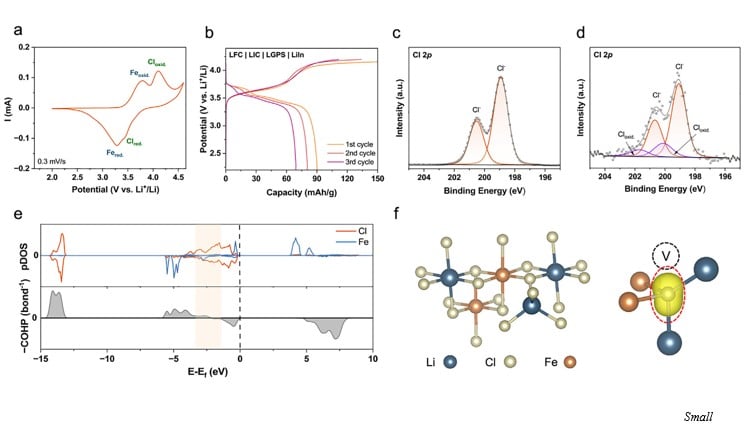
While oxygen and sulfur have been widely studied for anion redox in rechargeable batteries, the potential role of chlorine in chloride-based cathodes has remained less certain. To explore this, the researchers assembled all-solid-state cells using a Li₂FeCl₄ cathode, a Li₃InCl₆ solid electrolyte, a Li₁₀GeP₂S₁₂ interlayer, and a lithium–indium alloy anode.
Electrochemical measurements revealed two distinct oxidation stages during charging: a lower-voltage process near 3.8 V linked primarily to iron oxidation (Fe²⁺/Fe³⁺), and a higher-voltage feature near 4.2 V indicating an additional contribution from chlorine.
Using X-ray photoelectron spectroscopy, X-ray absorption spectroscopy, and density functional theory calculations, the team tracked changes in chlorine's electronic state. The calculations identified occupied, chlorine-derived nonbonding orbitals capable of providing charge compensation when electrons are removed.
Structural Insights and Future Challenges
The study also documented "reductive coupling," where iron centers showed signs of partial reduction at higher voltages rather than continuous oxidation, helping the material redistribute electronic charge and partially recover local structural symmetry following initial octahedral distortion.
Additionally, X-ray diffraction techniques revealed phase coexistence, lattice evolution, and spatially uneven changes within individual cathode grains during lithium extraction.
The authors noted that important hurdles remain before practical application, as the chlorine-associated high-voltage process was only partially reversible, and potential chlorine gas evolution under test conditions could not be entirely ruled out. Consequently, the study serves as a mechanistic foundation for future halide cathode design rather than a deployment-ready technology.
