
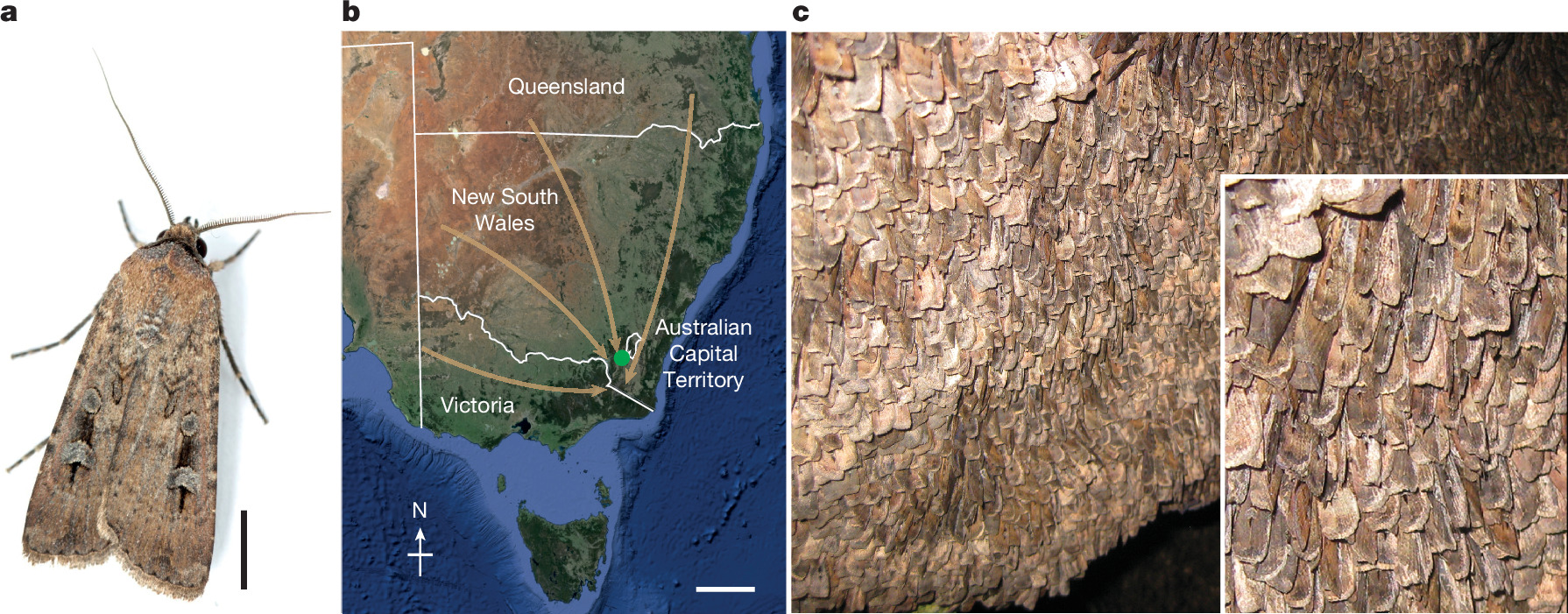
While it was previously understood that Bogong moths use celestial cues like stars to orient themselves, their ability to maintain a correct course under cloudy conditions suggested the presence of an internal magnetic sense. By testing tethered moths in a flight arena, scientists confirmed that the insects rely on the Earth’s magnetic field to determine their migratory direction.
How the Compass Works
The research team found that the moths' navigation is sensitive to the inclination of the geomagnetic field rather than its polarity. When researchers manipulated the magnetic field, the moths adjusted their flight path accordingly. Crucially, this magnetic sense is light-dependent; the study indicates that the mechanism requires exposure to violet-blue light to function, suggesting a biological process linked to photoreceptors.
This finding provides a significant breakthrough in understanding the sensory biology of migratory insects, confirming that Bogong moths possess a dual-navigation system that allows them to traverse vast distances across Australia with high precision.
