
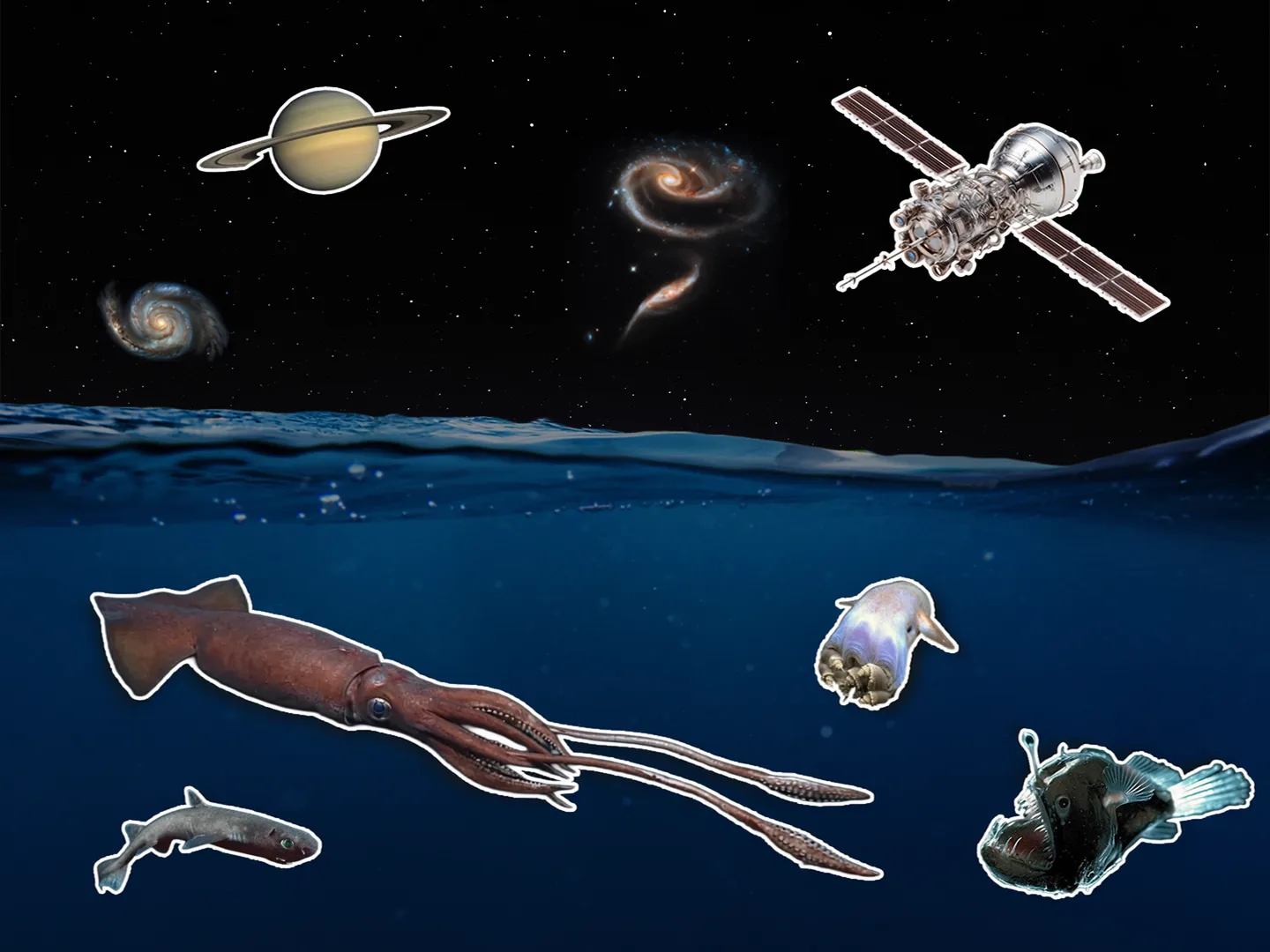
A popular saying suggests that humans know more about outer space than Earth’s own oceans, but experts note that defining and comparing what we truly “know” across these two vast domains is remarkably complex.
Mapping Disparities: Oceans Versus the Cosmos
According to oceanographer Associate Professor Jeff Hansen and astrophysicist Dr Kat Ross, exploring the deep sea faces significant technological hurdles. Because water absorbs electromagnetic radiation like lasers and radar, standard mapping tools fail beneath the surface, leaving the deep ocean pitch black. Scientists instead rely on sonar—pinging sound through the water—which is exceptionally slow. As of early 2026, only 28.7% of the ocean floor has been accurately mapped using sonar, prompting Hansen to remark that it is easier to map Mars.
Conversely, technologies designed to observe space encounter fewer obstacles from absorption. Optical and radio telescopes have allowed researchers to map vast expanses of the universe. Programs like the Dark Energy Spectroscopic Instrument have charted 75% of the night sky, while the Very Large Array Sky Survey has mapped 82%, peering through space dust where visible light cannot reach.
Unique Research Challenges in Both Realms
Despite more of the night sky being successfully mapped, both environments present severe research obstacles. In the deepest part of the ocean, the Mariana Trench, extreme pressures exceed 1000kg/cm², and GPS signals cannot penetrate the water's surface. Meanwhile, radio astronomy contends with heavy electronic interference known as “confusion.” Ross points out that the radio signals emitted by a simple mobile phone placed on the moon would outshine the brightest radio galaxies studied by astronomers, threatening future observations as satellite numbers grow.
Ultimately, experts highlight that both the ocean and space are dynamic, constantly changing environments. Because these fields are continuously in flux and difficult to constrain with a single definition of "knowledge," researchers agree that complete understanding remains out of reach, even as new discoveries continue to emerge.
