
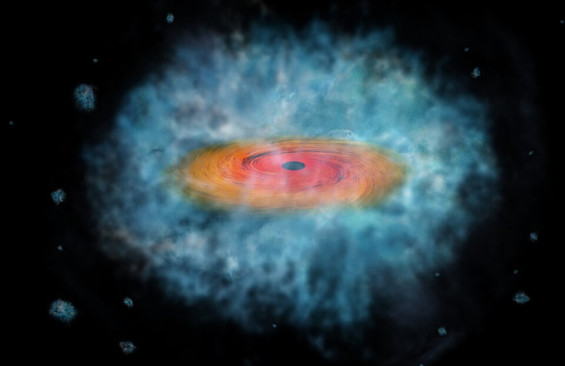
Astronomers are revisiting a cosmic "chicken or the egg" dilemma: whether galaxies formed first, or if supermassive black holes were the initial seeds that gathered matter to form galaxies. Recent observations from NASA’s James Webb Space Telescope (JWST) are providing critical clues from the early universe.
The Mystery of the "Little Red Dots"
Since the James Webb Space Telescope began its observations, it has identified mysterious, compact objects in the early universe known as "Little Red Dots" (LRDs). These objects appear as small, crimson points in telescope imagery, sparking debate over their true nature. Some researchers suggest they are dense, star-packed galaxies, while others argue they are active black holes shrouded in gas, emitting intense light as they consume surrounding material.
The identity of these objects remains a subject of intense study. Because black holes possess gravity so immense that even light cannot escape, researchers are investigating whether these objects indicate that black holes formed before galaxies, or that they grew at an accelerated rate while their host galaxies were still developing.
Evidence of Rapid Black Hole Growth
Recent research into the early universe has challenged conventional models of galactic evolution. By analyzing these early cosmic structures, scientists have begun to measure the mass of black holes in the early universe directly. These findings suggest that black holes may have grown much faster than previously anticipated.
While these findings do not definitively prove that black holes formed before galaxies, they strongly suggest that in the early universe, black holes either predated their host galaxies or underwent a period of rapid, disproportionate growth. Even if black holes and galaxies formed around the same time, the accelerated growth of the black hole could explain the observations seen today.
As scientists continue to analyze these early cosmic structures, they move closer to understanding the fundamental sequence of events that shaped the universe. Each "Little Red Dot" identified brings researchers one step closer to solving this ancient cosmic mystery.
