
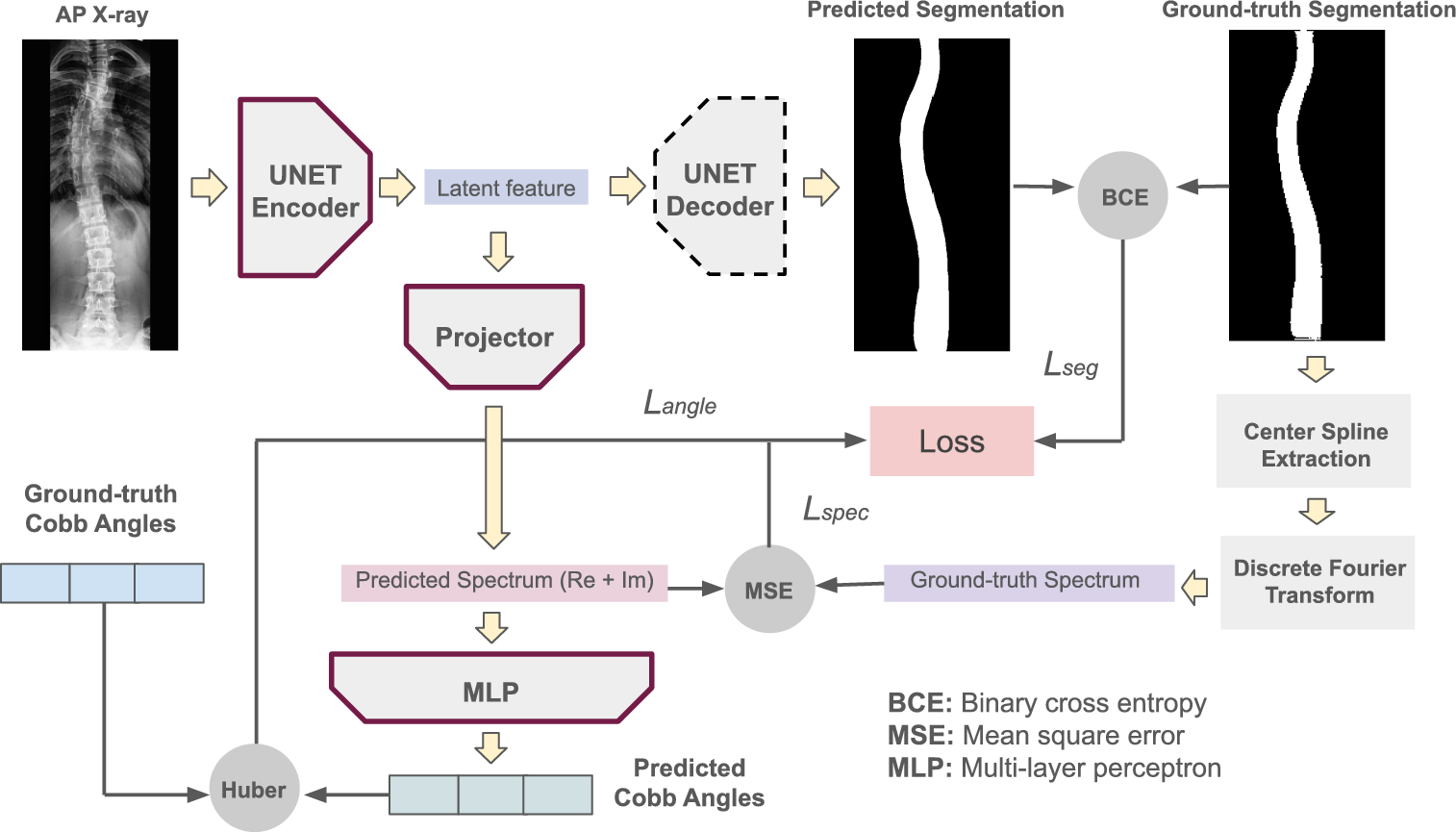
Published research in Nature details a new automated pipeline designed to measure Cobb angles from anteroposterior (AP) radiographs for the assessment of adolescent idiopathic scoliosis (AIS). The development addresses long-standing clinical challenges involving manual assessment consistency and labor-intensive procedures.
Tackling Subjectivity in Spinal Deformity Assessment
Cobb angle measurement from anteroposterior (AP) radiographs is the clinical standard for assessing adolescent idiopathic scoliosis (AIS). However, manual assessment is time-consuming and often inconsistent. Clinicians must subjectively select end vertebrae and place measurement lines, which introduces substantial inter- and intra-observer variability. To address these limitations, researchers introduced an automated pipeline.
To overcome these limitations, the research team developed a structured, frequency-domain approach. The pipeline extracts a centerline from a predicted spine mask, computes its low-frequency spectrum, and utilizes a projection head to regress concatenated real and imaginary Fourier coefficients. A lightweight multilayer perceptron then predicts the final Cobb angles from this spectral representation.
Evaluation and Performance
The top-performing configuration (downsampling factor 8, padded length 512) achieves a Dice coefficient reaching \(0.921 \pm 0.008\), and a curvature-feature cosine similarity of \(0.892 \pm 0.021\). In contrast, a weaker configuration (downsampling factor 32, padded length 128) yields a comparable Dice coefficient of \(0.919 \pm 0.013\) but a markedly lower curvature-feature cosine similarity of \(0.681 \pm 0.108\). These results suggest that accurate angle estimation depends not only on segmentation quality, but also on the expressiveness of the learned curvature feature representation.
