
Researchers have developed a new software package designed to improve direct imaging of exoplanets by optimizing physical models of telescopes to reduce background noise, according to a study published in Nature.
Overcoming the Starlight Challenge
Directly imaging exoplanets or analyzing light passing through their atmospheres remains a major challenge in astronomy because host stars are vastly brighter than their orbiting planets. While instruments called coronagraphs help block out a significant portion of a star's light, subtle variations in telescope configuration and pointing create residual noise that obscures planetary signals.
To address this, scientists face the hurdle of accurately determining a telescope's point spread function—the mathematical description of how hardware imperfections and pointing limitations blur a point of light. Traditional methods either rely on observing known targets, which can change over time, or attempting to tune complex hardware models that feature too many parameters for traditional computational approaches.
AI-Inspired Optimization with FLIP
Borrowing techniques from artificial intelligence development, a research team created a process called FLIP (Physics-based Learning for Imaging Planets). Utilizing gradient descent algorithms optimized for GPUs—similar to methods used to train large neural networks—the software optimizes a physical model of the James Webb Space Telescope's NIRCam, adjusting 106 possible parameters based on actual star data in roughly half an hour.
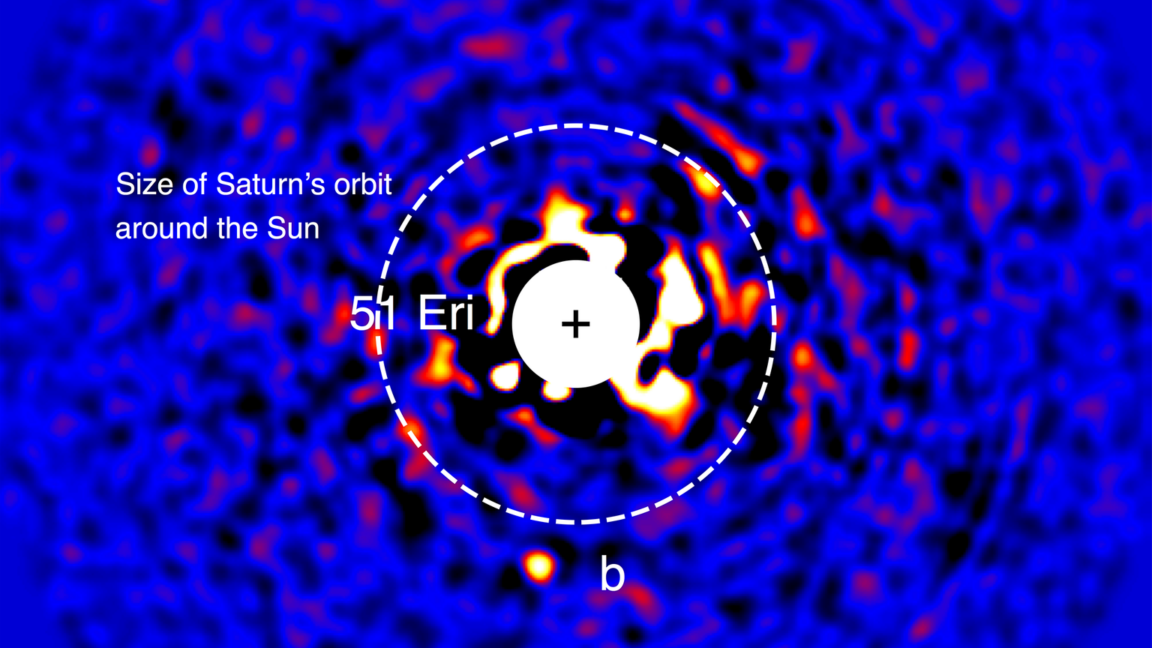
The team tested the software using Webb telescope observations of two stars with known exoplanets, HIP 65426 and 51 Eridani, as well as a variable star with no known planets, TYC 5899. The approach successfully boosted the signal-to-noise ratio by a factor of 1.5 to 2, allowing researchers to spot one of the planets at a carbon-dioxide-detection wavelength for the first time. For the variable star, the technique increased observation sensitivity by a factor of 15.
Scientists note that lowering imaging noise could help astronomers detect dimmer, older, or lower-mass planets that have previously evaded discovery.
