
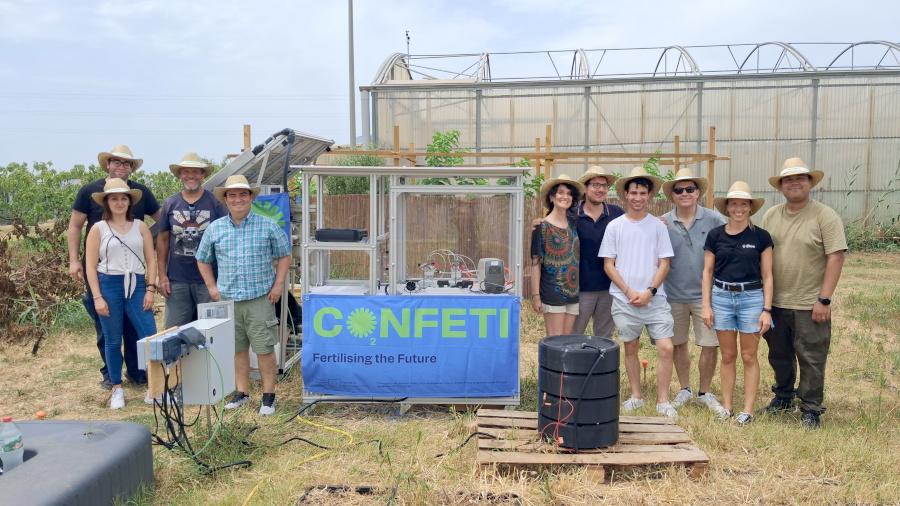
A European research consortium has successfully deployed a pilot system capable of producing urea—a vital nitrogen fertilizer—directly in an agricultural field. The project, known as CONFETI, aims to provide a sustainable, on-demand alternative to energy-intensive industrial fertilizer production.
Integrating Renewable Tech in the Field
The pilot installation, located in Viladecans, Spain, utilizes a combination of electrochemical and photochemical reactors to synthesize fertilizer. The system captures carbon dioxide (CO₂) and nitrates, converting them into urea using electricity generated by a hybrid setup of solar panels and biobatteries. These biobatteries uniquely harness microbial activity and organic matter found directly in the soil to power the process.
Additionally, the system features a photochemical reactor that uses sunlight to convert water-borne nitrates into ammonia, which is then recovered for use in urea production. This circular approach allows farmers to repurpose nitrates that crops fail to absorb, effectively turning potential pollutants into valuable agricultural inputs.
Moving Beyond the Laboratory
Coordinated by the Universitat Autònoma de Barcelona (UAB) and backed by nearly €4 million in European Innovation Council funding, the project spent three years transitioning from lab-scale experiments to real-world testing. Project coordinator Gonzalo Guirado noted that the primary challenge was adapting the technology to withstand unpredictable weather and environmental conditions outside the laboratory.
By producing fertilizer on-site, the CONFETI system eliminates the need for long-term storage and reduces the environmental footprint associated with traditional manufacturing. While the pilot has successfully operated through the summer and recent rainfall, researchers emphasize that further study is required to determine the long-term technical and economic viability of commercializing the technology.
