
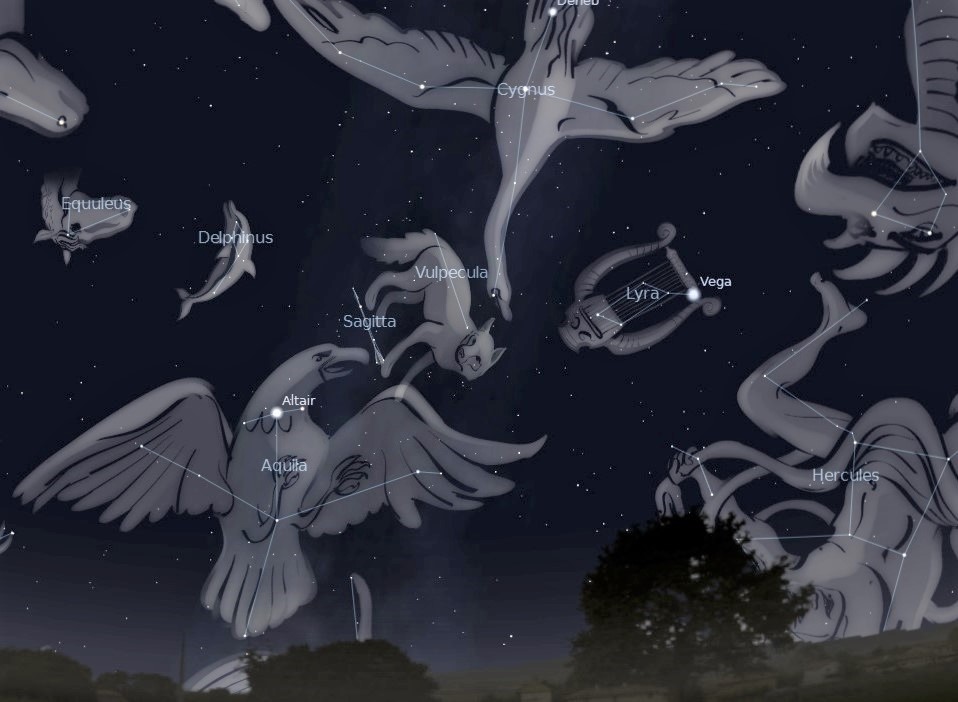
The column, published by Your Greater Moncton and attributed to Curt Nason of the Royal Astronomical Society of Canada’s New Brunswick Centre, suggests heading outside around 8:30 p.m. with a coat and some imagination to watch the summer constellations sink below the western horizon.
The Summer Triangle will be the first thing many observers notice, balanced on Altair and tipping to the right. Aquila the Eagle, with Altair at its head, will appear to flap futilely as it loses its battle to stay above the horizon over about two hours. To its right, Hercules dives head first, while the Milky Way may be visible between them from rural locations. Four smaller constellations — Lyra with Vega, Vulpecula, Sagitta and Delphinus — form a line above Altair, and observers can also try for the triangular head of Equuleus the Little Horse.
Sunrise, sunset and the Moon
Saturday’s sunrise in Moncton is at 7:18 a.m. and sunset at 4:48 p.m., giving 9 hours and 34 minutes of daylight. Saint John sees sunrise at 7:21 and sunset at 4:55, while Saint Stephen has sunrise at 7:26 and sunset at 5:00. By the following Saturday, Moncton’s sunrise shifts to 7:28 and sunset to 4:41, Saint John to 7:30 and 4:49, and Saint Stephen to 7:35 and 4:54, leaving 9 hours and 19 minutes of daylight.
The Moon reaches first quarter on Tuesday. Telescope users may catch the Lunar X inside the shadow around sunset on Monday.
Planets and the Leonids
Mars and Jupiter rise before midnight and sit close together high in the south on Saturday morning, within a binocular view of Regulus. Venus appears just above Spica in Virgo this weekend, rising before 5 a.m., while Mercury rises well before 6 a.m. and reaches greatest elongation from the Sun on Thursday. Saturn is at its best for telescope observing in the mid-evening.
The Leonid meteor shower peaks on Tuesday evening, adding a few extra shooting stars that morning and Wednesday.
Nason also invites readers to tune in to the Sunday Night Astronomy Show at 8 p.m. on the Facebook page or YouTube site of Astronomy by the Bay, and to direct questions to him by email.
