
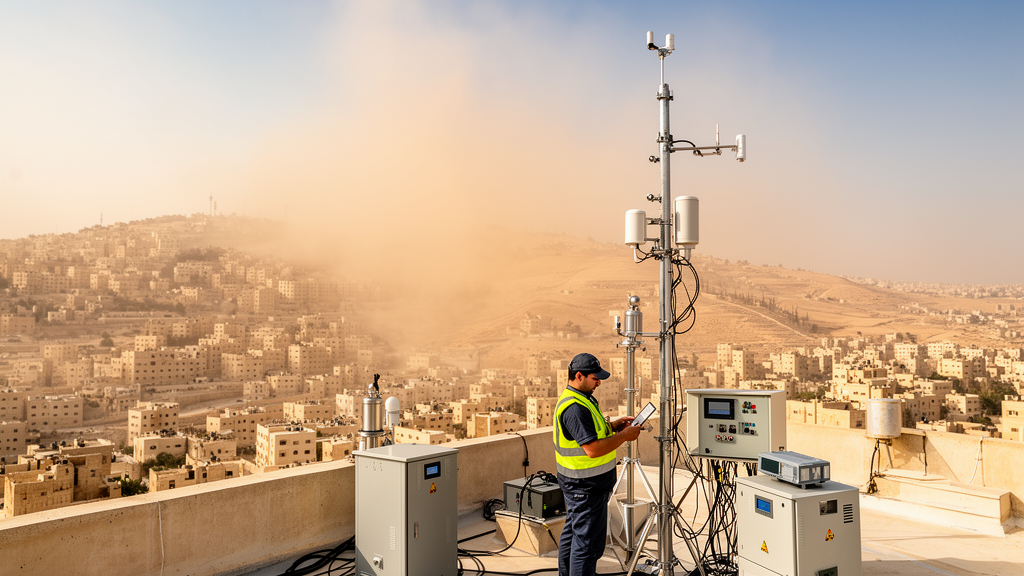
The hybrid model achieved coefficients of determination between 0.59 and 0.915 alongside mean absolute errors ranging from 1.6 to 6.6 micrograms per cubic meter. The framework provided reliable four-day forecasts for background environments and effective two-day predictions in complex urban, industrial, and traffic zones.
Predictive Fidelity and Operational Constraints
Performance varied based on the specific environment of the monitoring station. At the KHG background station, the model maintained robust predictive fidelity across all horizons, tracking empirical values with minimal lag. While peak prediction accuracy decreased during three-to-four-day projections, the model retained high overall correlation. In contrast, the HAJ traffic station showed mixed results; while one-to-two-day forecasts aligned with roadside trends, longer-term projections suffered from phase lag, over-smoothing, and underestimation of peak events, particularly during the winter months between December 2023 and March 2024.
At the GAM urban residential and KAC industrial stations, one-to-two-day predictions tracked observations accurately. However, three-to-four-day horizons at these sites showed diminished accuracy and muted peaks, reflecting the complex localized emission dynamics inherent to those environments.
Data Governance and Future Implications
Despite the technical success of the framework, the researchers identified significant operational hurdles regarding environmental data governance in Jordan. The study relied on semi-manual extraction of data from PDF reports published by the Ministry of Environment, which introduces potential for human or technical error. Furthermore, the lack of automated, machine-readable data streams and restricted access to complete raw monitoring records remain persistent challenges. The team also noted that missing observation rates ranged between 4.1 percent and 12 percent across the stations, with occasional sensor malfunctions identified during the outlier detection phase.
Ultimately, the investigators concluded that the SSA-MLP hybrid framework establishes a practical and highly adaptable foundation for environmental management. By demonstrating that statistical decomposition can deliver dependable air quality forecasts, the study provides a viable pathway for developing future public health early warning systems in Jordan.
