
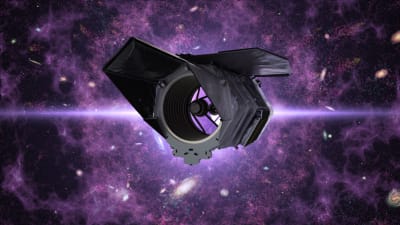
NASA’s Nancy Grace Roman Space Telescope has successfully lifted off from the Kennedy Space Center in Florida, marking the deployment of the agency's newest flagship space observatory. Operating far beyond Earth's protective magnetic field requires exceptionally resilient engineering, particularly when it comes to power systems. To ensure continuous operation during its mission, the telescope relies on specialized semiconductor technology designed to withstand the harsh conditions of deep space.
Journey to the Second Lagrange Point
The Roman Space Telescope is traveling to the second Sun-Earth Lagrange point (L2), located more than 1.5 million kilometers away from Earth. This is the same orbital position utilized by the James Webb Space Telescope, offering stable gravitational conditions and an unobstructed view of a wide swath of the sky.
Operating at L2 presents significant operational challenges. The observatory is scheduled to function in this environment for up to a decade with no possibility of physical maintenance or servicing. Consequently, onboard systems must perform reliably from day one.
Radiation-Hardened Power Architecture
Beyond Earth's protective magnetic field, unhindered high-energy particles constantly strike electronic components, posing a severe threat of permanent damage or total mission failure. To combat this, the spacecraft incorporates radiation-hardened HiRel power semiconductor devices from Infineon Technologies.
Rather than relying purely on passive shielding, these components utilize a semiconductor architecture that is inherently radiation-resistant by design. Qualified to MIL-PRF standards, the portfolio includes Total Ionizing Dose (TID) and Single Event Effects (SEE) characterizations, ensuring the necessary performance margins for sustained deep-space deployment.
The onboard integrated hardware includes:
- Radiation-hardened silicon power MOSFETs
- Gallium nitride (GaN) transistors, featuring JANS-qualified 100 V options
- Gate drivers and solid-state relays
- Specialized power diodes
The integration of advanced gallium nitride technology provides lower switching losses, higher power density, and higher switching frequencies. This efficiency reduces overall magnetic component requirements, delivering critical weight and volume savings at the system level.
Managing Massive Data Streams
Continuous, flawless power delivery is a strict prerequisite for the mission's primary scientific goals. Once fully operational, the Roman Space Telescope will downlink approximately 1.4 terabytes of raw science data every day to ground stations located in New Mexico, Australia, and Japan. This represents the highest daily data volume of any NASA astrophysics mission to date, demanding uninterrupted performance from all onboard instruments and transmission systems.
The successful launch adds to a deep space heritage for Infineon's components that stretches back to the 1970s, supporting hundreds of missions including navigation satellites, the International Space Station, and NASA's Artemis program.
