
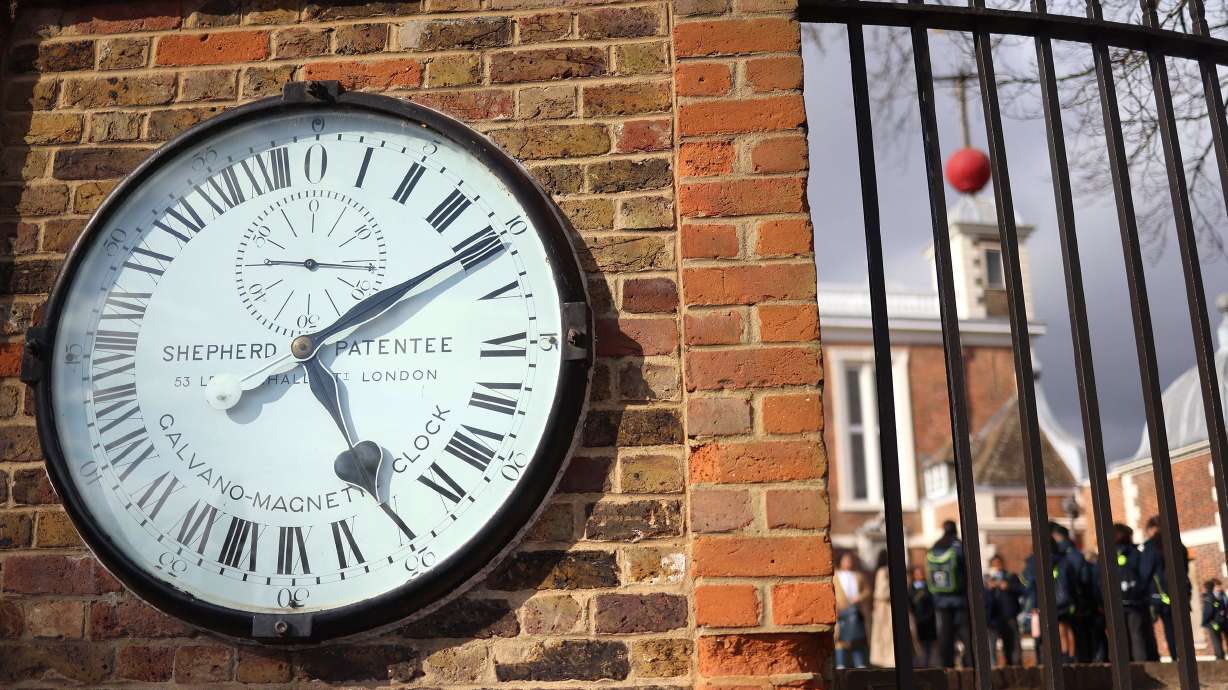
For centuries, human timekeeping has been anchored to the physical movement of the planet. From ancient sundials casting shadows as the sun moved overhead to the meridian line at the 351-year-old Royal Observatory Greenwich in London, time was fundamentally defined by Earth's rotation and the position of celestial bodies. However, this ancient connection is on the verge of being severed as international timekeepers prepare to vote on a proposal to eliminate the leap second.
The Clash Between Astronomical and Atomic Time
The leap second has historically served as a compromise between two distinct time-keeping methods:
- Astronomical time: Anchored by Earth's rotation and measured via observatories using the sky as a reference point.
- Coordinated Universal Time (UTC): The global standard set by ultraprecise atomic clocks developed in the 1950s, which track the stable vibrations of atoms.
The challenge arises because Earth is an imperfect clock. Its rotation wobbles and fluctuates due to the gravitational pull of the moon, shifts in the planetary core, and the movement of water and ice. These variations are further exacerbated by melting polar ice caps driven by the climate crisis. To keep astronomical and atomic time in sync, 27 leap seconds have been inserted into global clocks since 1972.
Digital Disruption and the Threat of a Negative Leap Second
While most people never notice a leap second, its irregular application — announced with only six months' notice — causes major disruptions for digital infrastructure. Precise time synchronization is vital for data servers, telecommunications, power grids, and financial trading systems. Past leap seconds have triggered outages and errors at prominent tech companies, including Reddit, LinkedIn, Qantas, and Cloudflare, prompting tech giants like Meta to push for its removal.
The urgency to address the issue has grown due to a shifting planetary trend. While Earth's rotation has historically slowed down over the long term, it has recently begun speeding up. This shift raises the unprecedented prospect of needing to *subtract* a second rather than add one — known as a negative leap second.
A 2025 report from the International Earth Rotation and Reference Systems Service estimated that the likelihood of a negative leap second will reach 30% by 2035. Deleting a second has never been attempted and could cause widespread digital havoc. The International Bureau of Weights and Measures (BIPM) warned that critical infrastructure operators are largely unprepared, with required financial preparations potentially rivaling the Y2K computer bug.
The Path Forward and Differing Perspectives
Meeting in Versailles near Paris, the 69 member states of the BIPM are scheduled to vote on a resolution to ditch the leap second, with the change taking effect in May 2027 if approved. A successful vote would establish Continuous Coordinated Universal Time, allowing atomic time to drift gradually away from Earth's rotation without ever adding another leap second.
Not everyone agrees with the change. Critics argue that the technical challenges of managing leap seconds are overstated and that maintaining an intrinsic, intellectually comforting link to Earth's natural rotation is valuable. Professor Marek Ziebart of University College London noted that abandoning the system forces software updates and redesigns across industries.
Under the proposed resolution, atomic time would be allowed to drift from astronomical time, though the maximum difference would be capped at 3,600 seconds, or one hour — a threshold that would take more than 3,000 years to reach. Louise Devoy, senior curator at the Royal Observatory Greenwich, noted that the shift will largely happen behind the scenes, leaving daily human routines and circadian rhythms unaffected in an increasingly technology-dependent world.
