
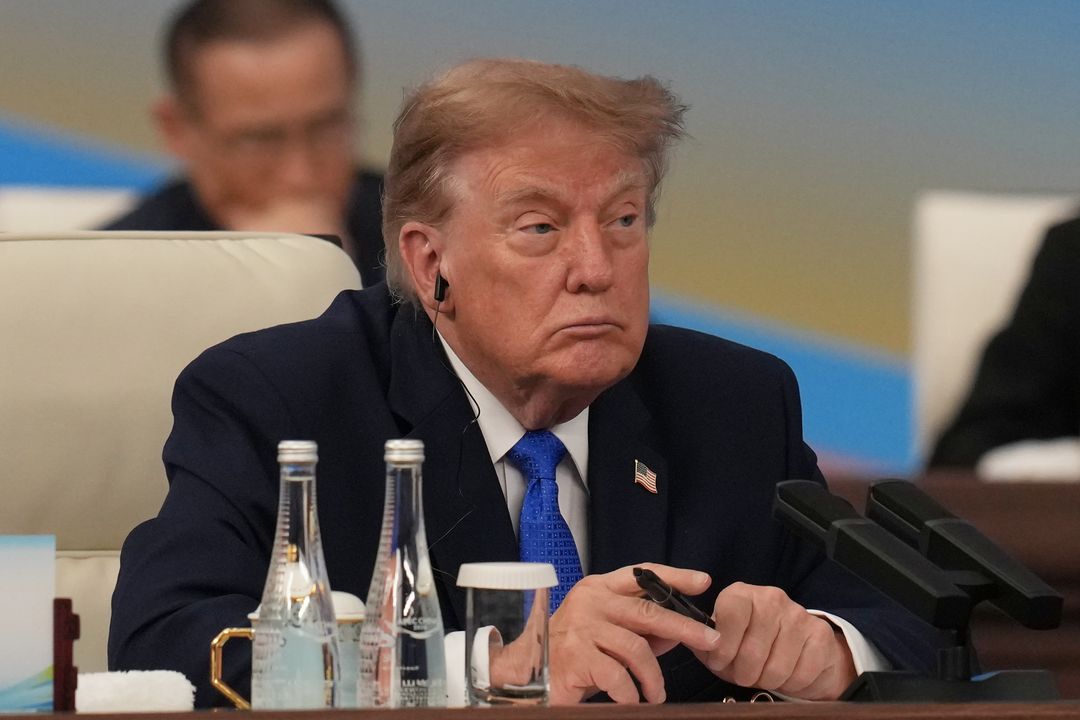
US President Donald Trump used the Asia-Pacific Economic Cooperation forum in Shenzhen, China, to reaffirm his administration’s position against multilateral oversight of artificial intelligence. Speaking at the 33rd APEC Economic Leaders’ Meeting, Trump framed the technology through his preferred lens of "superintelligence," declaring that Washington would not countenance any framework designed to "control or stifle" its development. His remarks come as the United States positions itself as a primary architect of the emerging sector, even as other economies push for coordinated guardrails.
AI Policy and the Rejection of Global Oversight
Trump’s comments mark a notable stance at a gathering where several member economies have signaled willingness to explore collective standards for rapidly advancing machine learning systems. The president argued that domestic vigilance suffices, stating that the United States must "watch" and "cherish" the technology rather than submit to external constraints. He described AI as "almost completely good," while conceding that it contains "some bad elements" requiring careful management. The remarks suggest a continued preference for unilateral action over the kind of multilateral accords that have defined climate and trade discussions at previous APEC gatherings.
Key Points from the Address
- Trump used the acronym "SI" to refer to superintelligence, a term he has employed previously to frame the technology’s transformative potential.
- He asserted that the United States is "proud to be the world leader in superintelligence," positioning the nation at the forefront of what he called the greatest technological shift since the Industrial Revolution.
- The president framed the technology as "almost completely good" but acknowledged the need to manage its hazardous components.
- His position rejects the notion of "globalist regulation" as a constraint on American innovation.
Energy and Geopolitics on the Sidelines
Beyond the AI remarks, Trump leveraged the APEC summit to advance energy and geopolitical objectives. The president highlighted the formal approval of an Alaska liquefied natural gas pipeline designed to export fossil fuels to Asian markets, framing the project as a boon for regional energy security. He also announced that US oil firms are "moving in" to develop reserves in Venezuela following political shifts in Caracas, declaring that "we're doing tremendous business" in the South American nation.
Scheduled Trilateral Talks
Trump confirmed he would later in the day meet with Chinese President Xi Jinping and Russian President Vladimir Putin on the sidelines of the summit. He characterized the encounter as "a historic trilateral meeting" intended to "discuss more opportunities for all three." The meeting underscores the complex diplomatic calculus at play, even as the United States maintains its opposition to coordinated AI governance.
Context and Implications
Trump’s stance reflects a broader administration approach that prioritizes national advantage in strategic technologies while resisting frameworks that could limit flexibility. By rejecting "globalist regulation" at a forum that includes major economies such as China and Russia, the United States signals its intent to shape AI development through domestic policy and market competition rather than consensus-based standards. The remarks also set the tone for the scheduled trilateral discussions, where AI governance may arise as a secondary topic alongside energy and security matters.
As the APEC summit continues, attention will focus on whether the United States can maintain its position against growing international momentum for coordinated AI safeguards, and how the planned talks with Xi and Putin may influence the broader geopolitical landscape.
