
Liquid Membranes Flex 100 Times More Easily than Cell Membranes
Researchers from the University of Osaka have made a groundbreaking discovery about the behavior of liquid membranes, which could have significant implications for our understanding of protocells and membraneless compartments in cells.
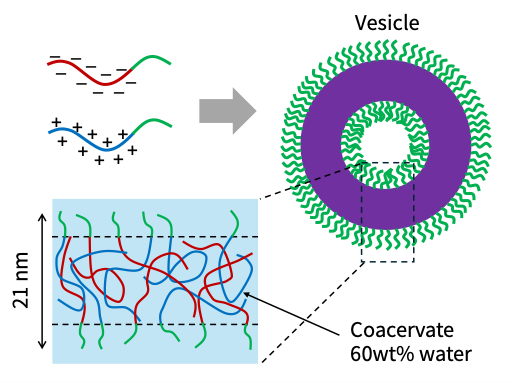
In a study published in Physical Review Letters, the team led by Rintaro Takahashi measured the bending and fluctuation of liquid membranes composed of coacervates, which are droplets of liquid that form when oppositely charged molecules come together in water. These liquid membranes are of interest because they may have played a role in the evolution of life on Earth, potentially serving as primitive cells before the emergence of modern cells with lipid membranes.
The researchers used a well-established system of vesicles formed by mixing two oppositely charged block copolymers in water. The membrane of these vesicles is made of a coacervate, giving it a membrane-like shape while its interior remains liquid-like. The team used neutron spin echo spectroscopy to measure the motion of these membranes, revealing that they bend 100 times more easily than lipid membranes.
The study found that the restorative force after bending deformation for the liquid membrane was entropic in origin, unlike the enthalpy-driven processes of lipid membranes. This discovery provides new insights into the behavior of liquid-based compartments, including those proposed as protocells, and could have significant implications for our understanding of the origins of life.
