
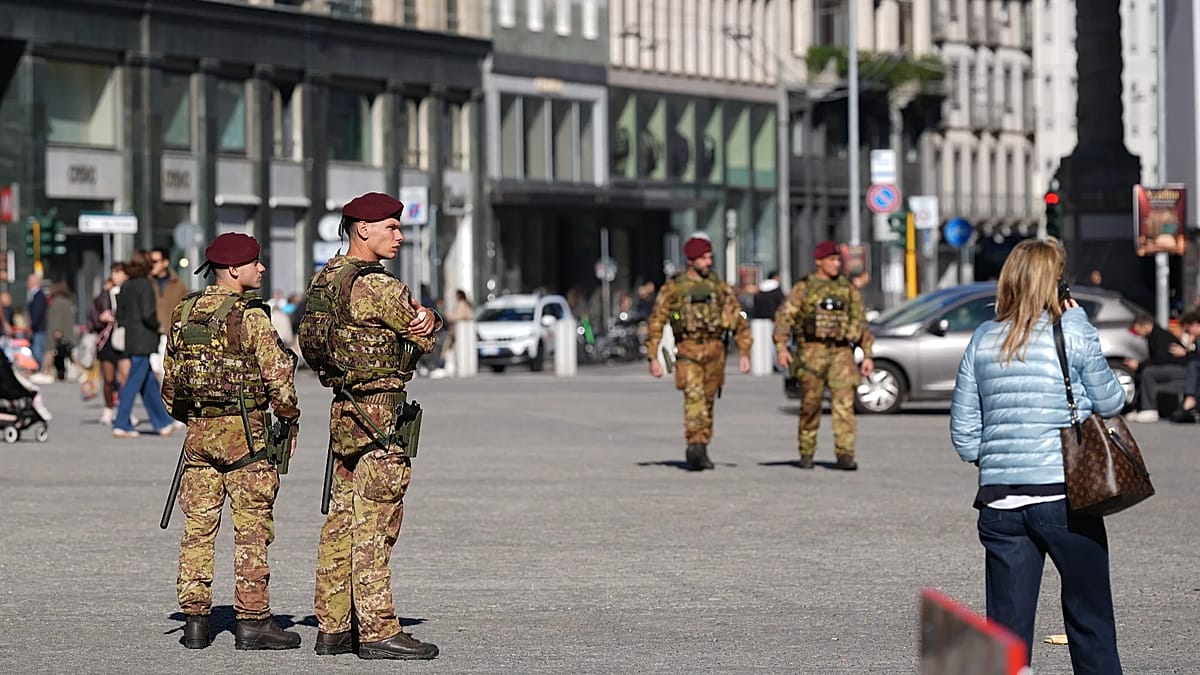
Italy Deploys Hundreds of Soldiers Amid Nationwide Protests
Italian authorities have deployed hundreds of additional soldiers and stepped up security across major cities on Saturday as a new wave of demonstrations raises fears of further violence following clashes between protesters and police. The protests, planned in Milan, Rome, Turin, Naples, and several other cities, are expected to voice anger over rising living costs, low wages, military spending, and government policies.
The city of Milan is on high alert after violent unrest, when clashes with police, vandalism, and looting caused widespread damage in the city center. In response, Prime Minister Giorgia Meloni's government has ordered the deployment of an additional 500 soldiers to Milan, reinforcing the security forces already stationed in the city. Authorities have also introduced drone surveillance, railway station checks, and rapid-response units to prevent further disorder.
Italian police carried out searches in Milan, Monza, and around 20 other cities as part of investigations into the violence. The searches targeted individuals suspected of involvement in the unrest, including students and minors. Interior Minister Matteo Piantedosi has suggested that the previous disturbances were coordinated, while authorities are investigating messages exchanged in online groups ahead of the latest demonstrations.
Demonstrations are also planned in Rome, Turin, and Naples, with protesters gathering under various slogans, including "Keep Italy out of the war" and "No to rearmament." The protests reflect a broad range of grievances across the country, from economic hardship and rising prices to access to housing, education, and healthcare.
The Italian government is under pressure to address the unrest, which has renewed debate over economic inequality, social exclusion, and the government's approach to public order. Authorities remain concerned that the demonstrations could bring together student movements, trade unions, and more radical activist groups, increasing the risk of further confrontations.
