
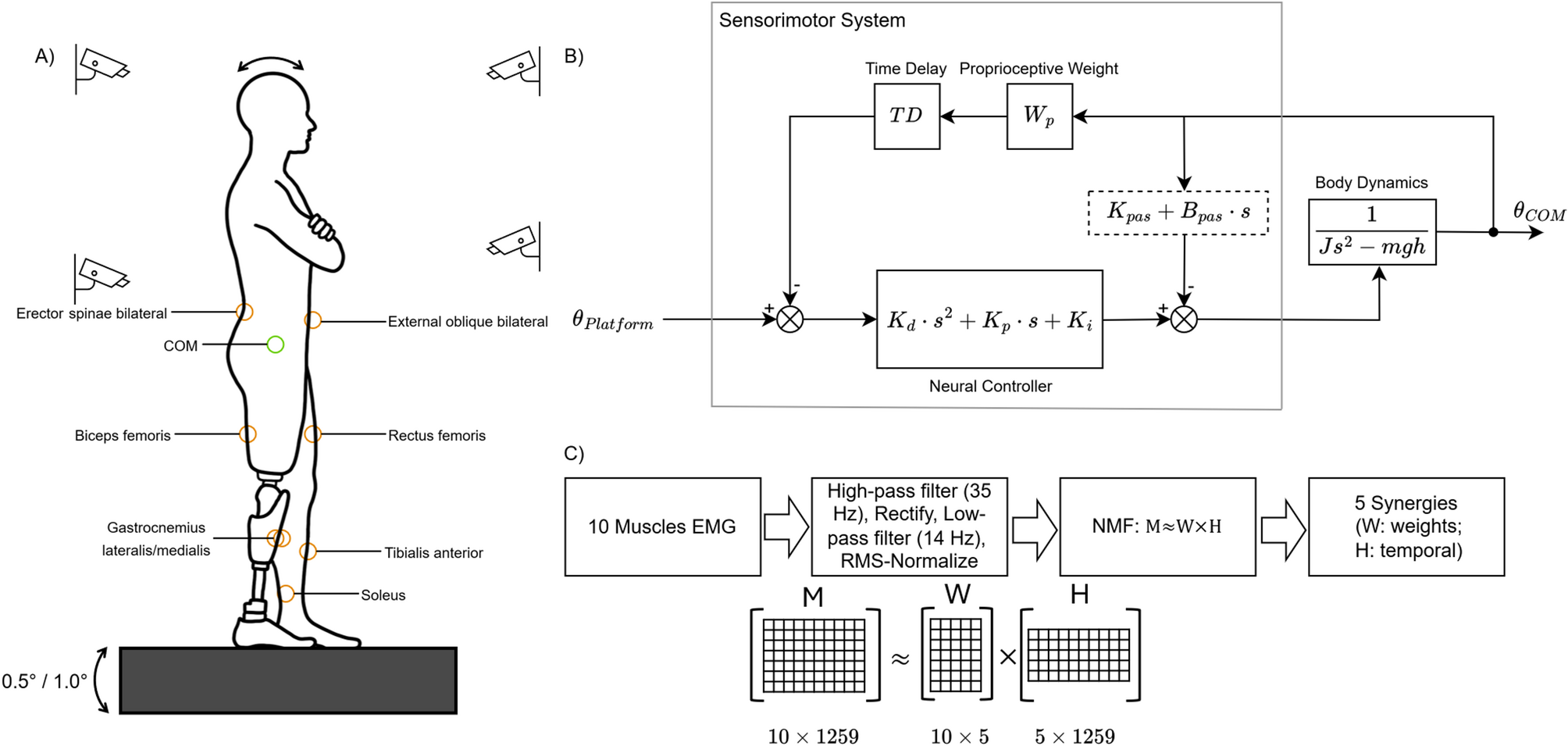
To quantify these sensorimotor adaptations, researchers conducted perturbed standing experiments comparing able-bodied control participants with individuals possessing unilateral transtibial (TTA) and transfemoral (TFA) amputations. Using an inverted pendulum model and transfer function analysis, the team evaluated proprioceptive weighting and neural controller parameters in response to external surface tilts. Additionally, non-negative matrix factorization was used to assess lower-body and trunk muscle synergies.
The findings demonstrated a pronounced reduction in proprioceptive contributions to postural control among transfemoral amputees, with proprioceptive weighting dropping to approximately 30% with eyes open, compared to about 70% in able-bodied controls. Despite this sensory reweighting, overall motor system gain remained preserved across the groups, though transfemoral participants exhibited frequency-dependent phase differences primarily when vision was unavailable.
Furthermore, the study identified altered muscle synergies characterized by increased contributions from proximal leg muscles—such as the rectus femoris—alongside a redistribution of trunk muscle contributions and condition-specific reductions in intact-side soleus activity. These insights suggest that postural instability following limb loss stems from sensory deficits that are counterbalanced by a proximal shift in muscle recruitment, which preserves motor response amplitudes while introducing temporal coordination constraints.
By mapping these quantitative biomarkers of sensory and motor adaptation, the research aims to inform the development of targeted rehabilitation interventions, personalized motor and sensory training, and improved prosthetic designs.
