
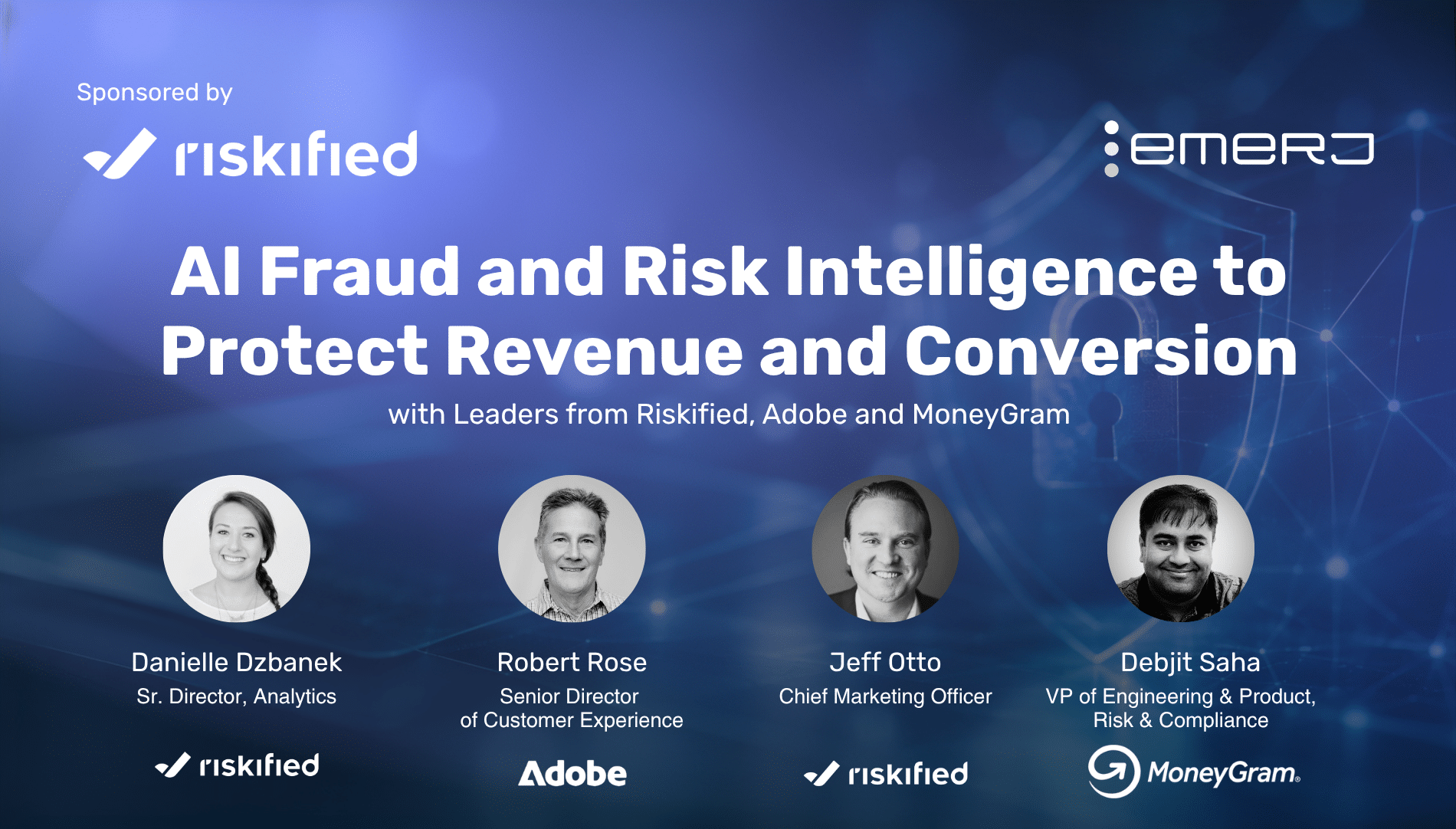
Online fraud is becoming increasingly expensive, leaving enterprise leaders with the complex challenge of stopping malicious actors without harming overall revenue and customer conversion. Recent data highlights the growing scale of the threat. In March 2026, the Federal Trade Commission reported to Congress that consumers lost $15.9 billion to fraud in 2025, up from just over $12 billion the previous year. Meanwhile, the FBI’s Internet Crime Complaint Center logged over one million complaints and nearly $21 billion in losses, dedicating a section of its annual report to AI-enabled schemes for the first time. For merchants and money-movement businesses, every defensive action carries a secondary risk: declining a legitimate transaction, adding unnecessary verification friction, delaying a refund, or turning away a valuable customer. ## The Challenge of Isolating Bad Actors In a webinar series produced with Emerj in partnership with Riskified, industry leaders examined how fraud is shifting from isolated transactions to broader identities and behavioral patterns. Experts participating in the series included: * Jeff Otto: Chief Marketing Officer at Riskified * Danielle Dzbanek: Senior Director of Analytics at Riskified * Robert Rose: Senior Director of Customer Experience at Adobe * Debjit Saha: VP of Engineering and Product, Risk and Compliance at MoneyGram When analyzing merchant populations, Jeff Otto notes that identities associated with losses typically represent roughly 20 basis points of the customer base—a proportion he compares to "a few drops of poison in a lake." Because one individual may operate dozens of accounts, these bad actors rarely look small inside transactional systems. Successfully isolating this tiny population allows businesses to remove friction for everyone else. According to Otto, merchants that identify strong customers early and offer faster refunds have seen repurchase rates double and complaint rates fall. ## Distinguishing Intent from Policy Abuse Robert Rose highlights the importance of evaluating customer intent. For example, a parent ordering the same item in multiple colors to find the right one may generate an expensive returns profile while acting in completely good faith. Although the raw outcome resembles abuse, the underlying intent is legitimate. Advanced artificial intelligence helps distinguish between the two by combining transactional history, identity, and behavior. Rose categorizes policy abuse—such as repeat refund requests, repeated cancellations, or promotion misuse—in the space between traditional fraud and general customer dissatisfaction. When these behaviors spread across channels, frontline support teams often struggle to interpret situations that do not fit neatly into established categories. "This often creates backlogs," Rose explains. "It creates inconsistent resolutions. It creates tension between the customer experience teams that are chasing that satisfaction goal and the risk teams that are looking to prevent loss." ## Bridging the Gap Across Enterprise Silos Payment fraud, ecommerce, and loss-prevention teams often operate within different reporting structures and optimize toward competing goals. At large enterprises, coordination cannot rely solely on informal conversations; it must be embedded directly into systems, policies, and shared data. Rose identifies the gap between human and automated channels as a primary point where policies break down. Automated AI chatbots apply rules consistently, but when a frustrated customer escalates an issue, human agents measured on customer satisfaction often apply more empathy than formal policy allows. To solve this, Rose recommends creating a feedback loop between people and automation: AI can coach agents when they drift from policy, and insights gathered by agents on phone calls can be fed back into chatbots to ensure consistency across all channels. Otto adds that organizations can achieve significant financial gains by applying risk intelligence across the entire customer journey, spanning checkout, claims, returns, and chargebacks.
Article
AI Fraud and Risk Intelligence to Protect Revenue and Conversion - Emerj Artificial Intelligence Research
Online fraud is becoming increasingly expensive, leaving enterprise leaders with the complex challenge of stopping malicious actors without harming overall revenue and customer conversion...
Primary sourceGlobal · Artificial Intelligence ↗
