
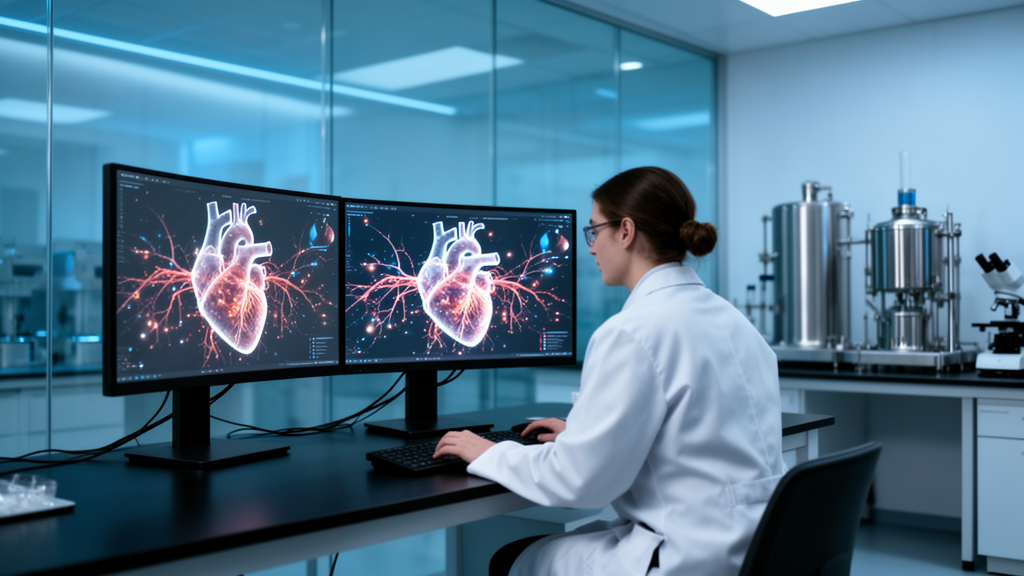
Artificial intelligence is rapidly reshaping biological digital twins, expanding their capacity to model human health and disease across multiple levels of organization. A theoretical analysis published on November 18, 2026, in Frontiers in Artificial Intelligence explores how advanced deep learning, foundation models, and physics-informed neural networks are elevating biological simulations. While these computational tools offer a promising path to replace traditional animal testing with human-relevant methodologies, the study cautions that scientific validation and lifecycle governance continue to dictate the speed of regulatory acceptance.
Authored by toxicologist Thomas Hartung, the analysis—titled "TwAIns: how artificial intelligence transforms biological digital twins from cell to population, and why validation is the limiting factor"—emphasizes that technical achievements alone cannot secure regulatory trust. Without agreed credibility standards, independent testing, and robust governance frameworks, biological twins risk falling short in high-stakes clinical and toxicological decisions.
Defining True Biological Digital Twins
To differentiate authentic biological digital twins from superficial marketing terms, software dashboards, and static pattern predictors, the research establishes four mandatory criteria:
- Specificity: The computational state must bind to a distinct biological instance—such as a single patient or an individual organ-on-chip—rather than representing an average population category.
- Continuous Data Assimilation: The system requires an iterative feedback loop where incoming telemetry, biosensor readings, or longitudinal omics samples update the model to track physical changes in the living system over time.
- Mechanistic Constraints: Simulations must incorporate biological principles alongside statistical correlations to prevent algorithms from generating biologically impossible outcomes.
- Empirical Testability: The architecture must produce refutable predictions accompanied by quantified uncertainty that physical experiments can verify or disprove.
Scaling From Cells to Populations
The study breaks down biological digital twins into a nested hierarchy spanning five distinct levels, starting from single cells and extending to entire populations. At the cellular level, foundation models like Geneformer, scGPT, and scFoundation leverage massive multimodal datasets to compress cellular profiles and filter out technical batch artifacts. These virtual cell frameworks allow researchers to simulate pharmacological perturbations and genetic knockouts, helping prioritize hypotheses for bench testing while minimizing early reliance on rodent models.
At the *in vitro* level, computational models combine with microfluidic devices and organoid systems. Systems like the DigiLoCS liver-on-chip framework integrate intracellular metabolism and transport equations to predict drug clearance distributions with high accuracy. Meanwhile, patient-derived organoid twins supported by active learning offer human-relevant alternatives to patient-derived xenograft rodent models.
Validation and Governance Challenges
Despite these technological strides, the analysis highlights that validation remains the primary hurdle. Mathematical unidentifiability, where multiple parameter combinations yield identical outputs, can obscure how reliable a model truly is. Furthermore, self-updating algorithms present a regulatory paradox: locking model parameters prevents adaptation and undermines performance, yet unrestricted parameter drift can quietly invalidate earlier validation evidence.
To address these issues, the report advocates for strict lifecycle governance protocols, including code version control, locked sentinel datasets to detect behavioral drift, and standardized credibility packages detailing a twin's context of use and quantified uncertainty.
Path Forward for Regulatory Adoption
To transition these tools into reliable regulatory instruments, the study recommends focusing on narrow, auditable use cases with clear decision boundaries—such as exposure prevention and initial toxicity screening. By standardizing physical measurements, harmonizing frameworks like the OECD Guidance Document 34 revision, and fostering interdisciplinary education, the scientific community can establish biological digital twins as trustworthy pillars of human-relevant biomedicine.
