
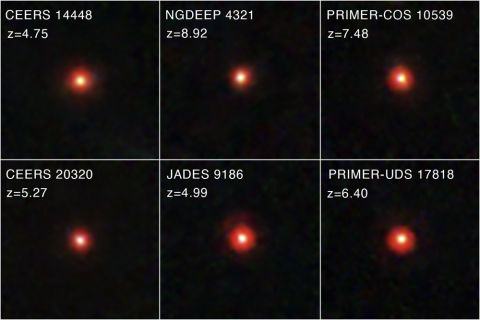
Since its deployment, the James Webb Space Telescope (JWST) has consistently challenged established models of the early universe. Among its most perplexing discoveries were the "Little Red Dots"—compact, intensely luminous objects that appeared to defy conventional astronomical classification. For months, these mysterious points of light left researchers questioning whether they were witnessing an unprecedented population of ancient galaxies or something entirely different.
New research has now provided a compelling explanation for these enigmatic features. By utilizing advanced computational simulations, astronomers have determined that these objects are likely the foundational environments where the universe's first supermassive black holes were forged.
Decoding the Little Red Dots
The "Little Red Dots" earned their name due to their distinct appearance in deep-field infrared imagery. Their compact size and reddish hue suggested they were either extremely distant, dust-obscured galaxies or something more exotic. Because these objects appeared to exist much earlier in cosmic history than standard galaxy formation models predicted, they created a significant tension in modern astrophysics.
To resolve this, researchers turned to sophisticated simulations designed to replicate the conditions of the early universe. These models allowed the team to test various scenarios regarding the growth and behavior of matter shortly after the Big Bang. The results indicated that the light signatures observed by the JWST are consistent with the intense radiation emitted by gas being rapidly consumed by growing black holes, rather than the light of mature star clusters.
The Birth of Supermassive Black Holes
The findings suggest that these dots represent a critical phase in cosmic evolution. Instead of being fully formed galaxies, these objects appear to be the "nurseries" of supermassive black holes. In these dense, high-energy environments, black holes are able to accumulate mass at rates far exceeding what was previously thought possible in the early stages of the universe.
This discovery helps bridge a long-standing gap in our understanding of how supermassive black holes—which now reside at the centers of most large galaxies—grew to such immense proportions so quickly. By identifying these objects as the primary engines of early black hole growth, astronomers can better map the timeline of how the first structures in the universe transitioned from primordial gas to the complex galactic systems observed today.
A New Era of Cosmic Discovery
The resolution of the "Little Red Dots" mystery highlights the unique capability of the JWST to not only capture data but to force a re-evaluation of theoretical frameworks. As the telescope continues to peer into the deepest reaches of space, the ability to combine high-resolution observational data with complex simulations is proving essential for interpreting the most distant and energetic events in cosmic history.
This breakthrough serves as a reminder that the early universe was far more dynamic and efficient at building massive structures than previously assumed. With this new understanding, researchers are now better positioned to investigate the specific mechanisms that triggered the formation of these early black holes and their subsequent influence on the evolution of the surrounding cosmos.
