
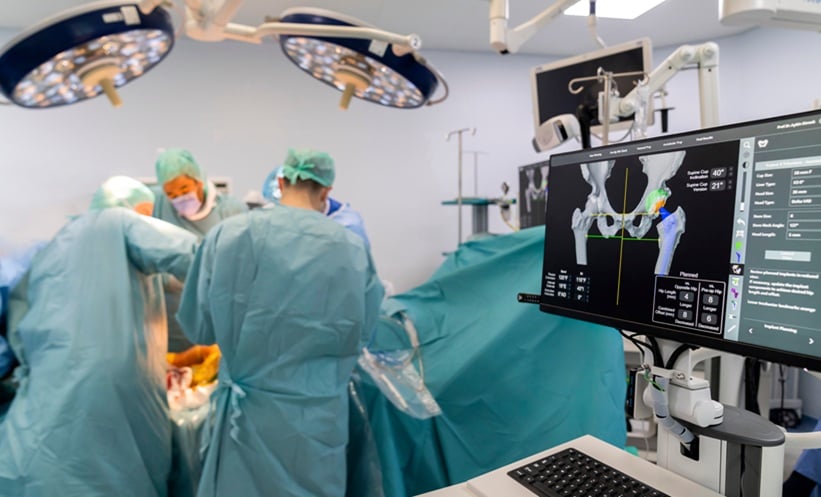
Recent research highlights the potential of full robotic navigation to enhance surgical precision and perioperative outcomes in orthopedic care. A retrospective cohort study investigated the technique's effectiveness in patients undergoing proximal femoral nail antirotation (PFNA) fixation for intertrochanteric fractures.
By comparing full robotic assistance against partial robotic methods and traditional freehand approaches, the study provides valuable insight into how advanced technology can streamline hip fracture management.
Evaluating Surgical Approaches in a Retrospective Study
The retrospective cohort study assessed a total of 121 patients who underwent PFNA fixation to treat intertrochanteric fractures. Researchers divided the patient cohort into three distinct intervention groups to evaluate differences in efficiency, radiation exposure, and blood loss:
- Full Robotic Navigation: Utilized in 41 patients.
- Partial Robotic Assistance: Applied in 40 patients, using robotic navigation solely for the main nail while relying on freehand determination for the anteversion angle.
- Conventional Freehand Fixation: Performed in 40 patients using standard manual techniques.
Key Perioperative and Efficiency Findings
The investigation demonstrated notable advantages associated with the integration of full robotic systems during the fixation procedure. Most prominently, the number of attempts required to accurately determine the anteversion angle was significantly reduced using the full robotic approach.
Specifically, procedures utilizing full robotic navigation averaged 1.22 attempts to determine the anteversion angle. In contrast, the partial navigation group required an average of 4.30 attempts, while the conventional freehand technique averaged 3.98 attempts.
Furthermore, the data indicated that full robotic navigation contributed to reduced fluoroscopy use and lower intraoperative blood loss when compared to the partial assistance and conventional methods.
Clinical Implications and Anatomical Considerations
The findings suggest that full robotic navigation offers meaningful perioperative advantages over both partial assistance and traditional freehand techniques in intertrochanteric fracture fixation. However, researchers noted that underlying anatomical factors continue to play a role in influencing overall positioning accuracy, indicating that technology serves as a powerful aid rather than a complete override of anatomical challenges.
