
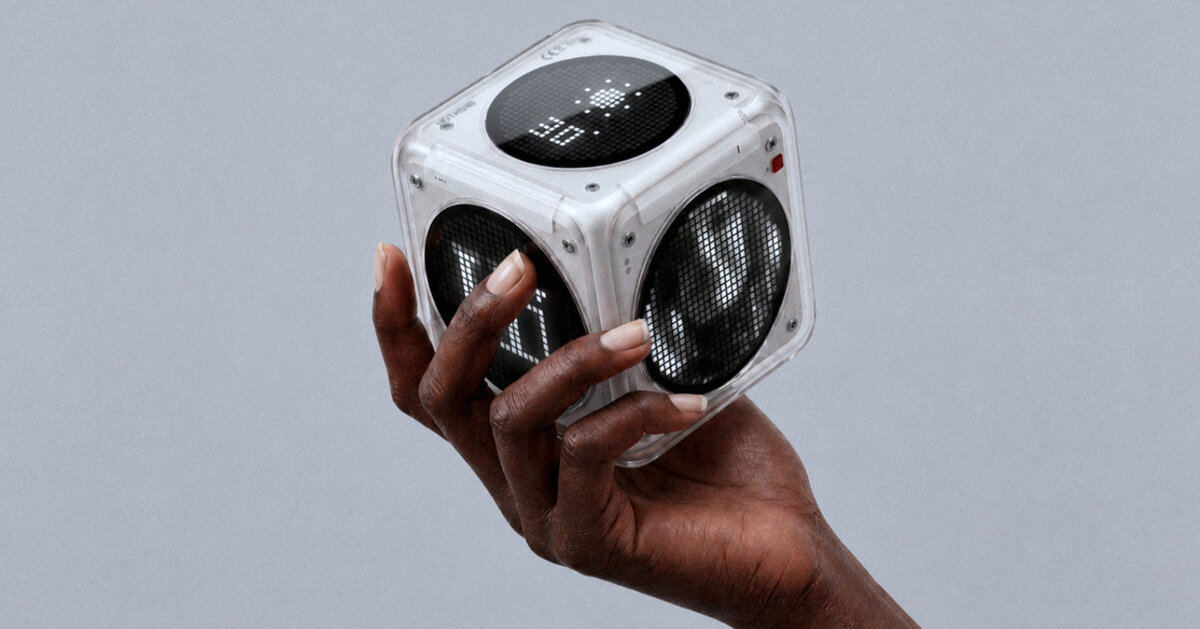
The landscape of artificial intelligence interaction typically revolves around glowing smartphone displays, app sub-menus, and touchscreens. Challenging this screen-heavy paradigm, industrial designer Adam Miklosi has introduced a speculative design concept called Glyph (1). Inspired by the distinctive design language of the consumer tech brand Nothing, this conceptual hardware reimagines an AI companion as a physical, distraction-free object that completely eliminates traditional screens.
Housed in a compact form factor, the device introduces an analog, rotational interface driven entirely by physical orientation. Rather than navigating complex digital menus, users interact with the hardware through spatial gestures and tactile positioning.
Transparent Architecture and Materiality
At the core of the design is a six-sided, transparent molded polycarbonate enclosure featuring soft, radiused edges. Through this clear outer shell, a textured inner chassis remains visibly exposed, emphasizing the mechanical and structural integrity of the object.
The concept is presented in distinct monochrome editions, featuring both black and white colorways. This minimalist aesthetic reflects the industrial design cues associated with Nothing tech, focusing on transparency, exposed components, and stark contrast.
Rotational Gestures and Spatial Interaction
Glyph (1) replaces conventional digital navigation with spatial orientation. Internal orientation sensors detect how the cube is positioned in physical space, allowing users to control the device simply by turning it:
- Rotating the cube so a specific facet faces upward automatically activates its programmed digital mode.
- Each of the six faces can be mapped to dedicated operations by the user.
- Configurable functions include smart-home controls, audio playback management, task timers, and an ambient AI voice assistant.
Independent Glyph LED Matrices
To provide feedback without relying on a conventional screen, each of the six faces integrates an independent programmable Glyph LED matrix. These embedded lights are capable of displaying customized graphic indicators, real-time notifications, and system telemetry directly through the transparent housing. By combining internal motion sensing with matrix illumination, the conceptual hardware offers a tactile method for managing digital tasks away from traditional displays.
