
As November moves into its final third, stargazers have a wealth of celestial sights to explore. From planetary pairings and shifting constellations to the unique timing of late-autumn sunsets, the night sky provides plenty of rewarding targets for both casual observers and dedicated backyard astronomers.
Evening Moon Pairings and Orion's Ascent
The week kicks off with notable planetary and lunar encounters. On the evening of November 20, the Moon and Saturn shine close together—appearing half as far apart as they did the previous night for viewers across the Americas. Observers can contextualize this view by considering scale: Saturn sits roughly 3,500 times farther away and is 35 times wider in diameter than the Moon (excluding its rings). If the Moon were a bright marble just six feet in front of you, Saturn would be a large, sunlit beach ball four miles in the background.
As winter approaches, the constellation Orion clears the eastern horizon as early as about 8 p.m. now. Orion's tilt while rising depends on your latitude! If you live north of 33° N (Los Angeles, Atlanta, the Nile delta, New Delhi, Shanghai), bright Betelgeuse in Orion's shoulder will be a little higher than bright Rigel marking his leading foot.
Morning Planets and Full Moon Highlights
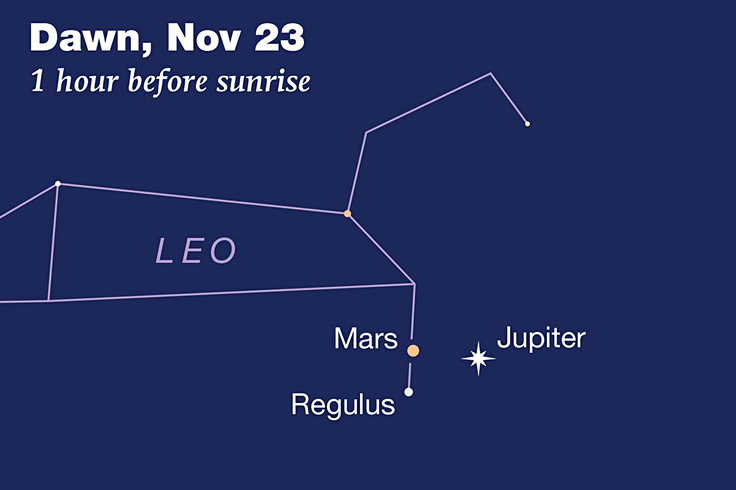
Early risers have plenty to look at during dawn hours. Toward the east-southeast, Venus, Mercury, and the star Spica continue to drift apart, with Mercury reaching its highest altitude for this apparition as seen from mid-northern latitudes. Meanwhile, a second, higher morning trio featuring Jupiter, Mars, and Regulus groups closely together inside a tight circle, rapidly morphing from morning to morning as Mars speeds eastward.
On the evening of November 22 and the days surrounding it, the Moon reaches its exact full phase. The full Moon shines near the Pleiades cluster; covering the glaring lunar disk with your fingers can help reveal the delicate stars behind it. By the following evening, the Moon shifts farther away from the cluster.
Later in the week, skywatchers looking high in the northeast during early evening will find Cassiopeia shaped like an upright "W," which rotates into a flattened "M" positioned high in the north by late night.
The Mystery of Early Sunsets
Thanksgiving week brings a familiar seasonal quirk: the realization that the Sun appears to set just about as early as it ever will, despite the winter solstice sitting nearly a month away. For observers near 40° north latitude, the earliest sunset actually occurs around early December.
Consequently, the Sun sets a fraction earlier on Thanksgiving than it does on Christmas Day, even though Christmas is much closer to the solstice. This celestial offset is neatly balanced out by sunrise times, which do not peak in lateness until early January—an imbalance driven by the tilt of Earth's axis and the eccentricity of its orbit.
The Evolution of Telescopic Technology
Beyond manual stargazing, the amateur astronomy community continues to adapt to rapid technological shifts. Traditional debate once centered on whether computerized scopes or star maps were better for beginners learning the sky. Today, modern software can recognize any star field instantly, bypassing traditional mechanical aiming imperfections.
Furthermore, the rise of small, photography-only smartscopes integrates advanced imaging chips, real-time stacking, and processing right into compact units. These devices allow users to view deep-sky images directly on phones or computers, fundamentally changing the entry-level astronomy experience.
