
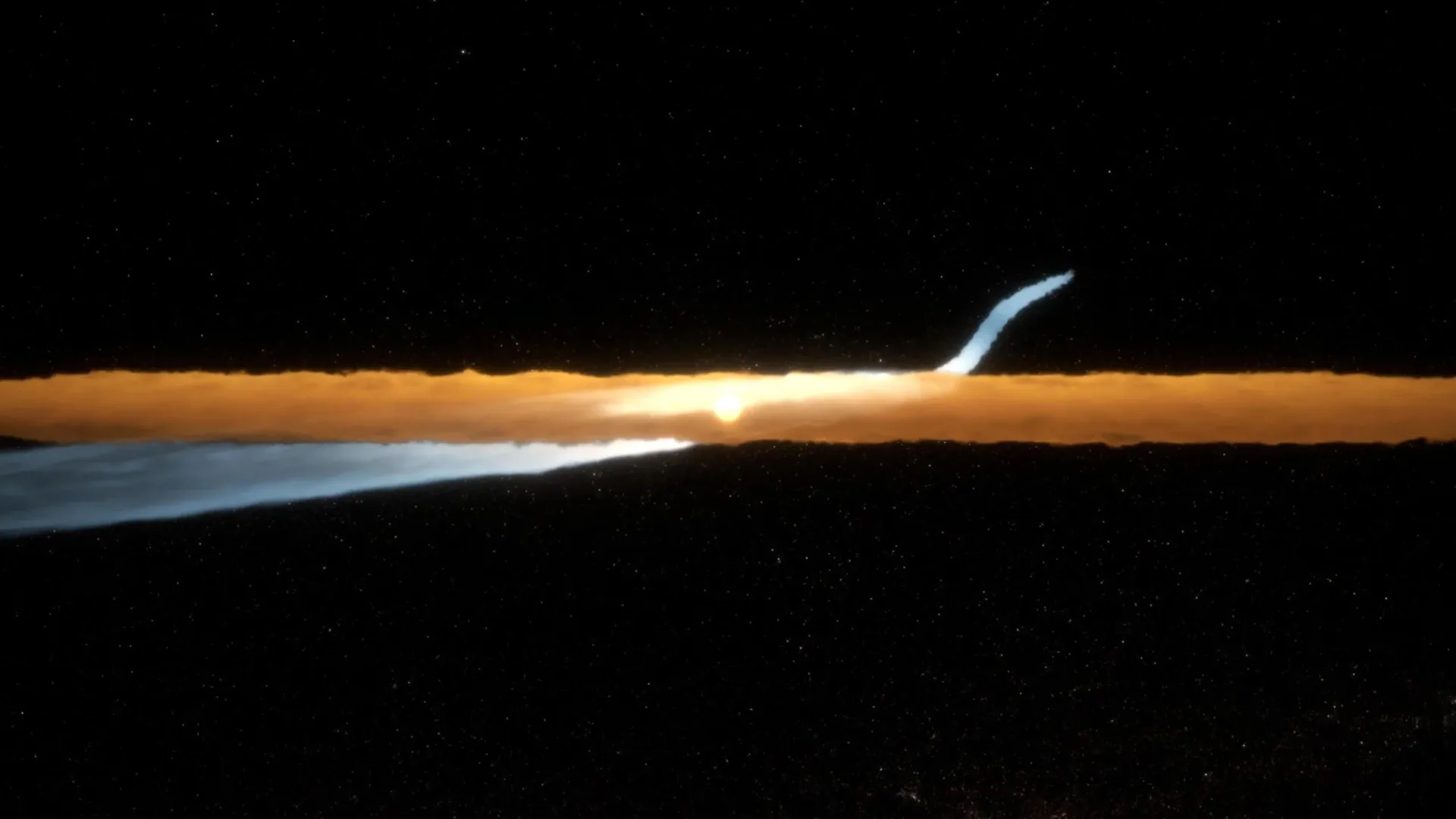
Astronomers using NASA's Hubble Space Telescope have captured unprecedented visible-light details of a mysterious 93-billion-mile cosmic structure known as the "Cat's Tail." Located roughly 63 light-years from Earth in the constellation Pictor, the massive cloud of dark material is part of a debris disk surrounding the young star system Beta Pictoris.
Published in The Astrophysical Journal Letters, a new study led by University of Arizona planetary scientist Arin Avsar combines fresh Hubble imagery with over 14 years of observations. The findings suggest the immense structure—stretching about 1,000 astronomical units—may be the violent aftermath of a collision between massive, Pluto-sized planetary bodies.
Previously detected only in infrared light by the James Webb Space Telescope, the Cat's Tail remained invisible at shorter wavelengths because of its composition. Researchers found that the cloud consists almost entirely of heavily carbon-based organic refractory materials that absorb visible light. Furthermore, the structure is composed of extremely small, highly porous dust grains measuring about a micron across, which scientists theorize may have formed when intense impact velocities vaporized carbon material before it recondensed during cooling.
In addition to clarifying the structure's physical shape and sideways orientation relative to Earth, the observations revealed an unexpected warp in the surrounding dust halo. Researchers attribute this distortion to the gravitational influence of Beta Pic b, a gas giant roughly ten times the mass of Jupiter. By studying these distant cosmic interactions, scientists hope to gain deeper insights into the violent collisions and planetary migrations that shaped our own early solar system.
