
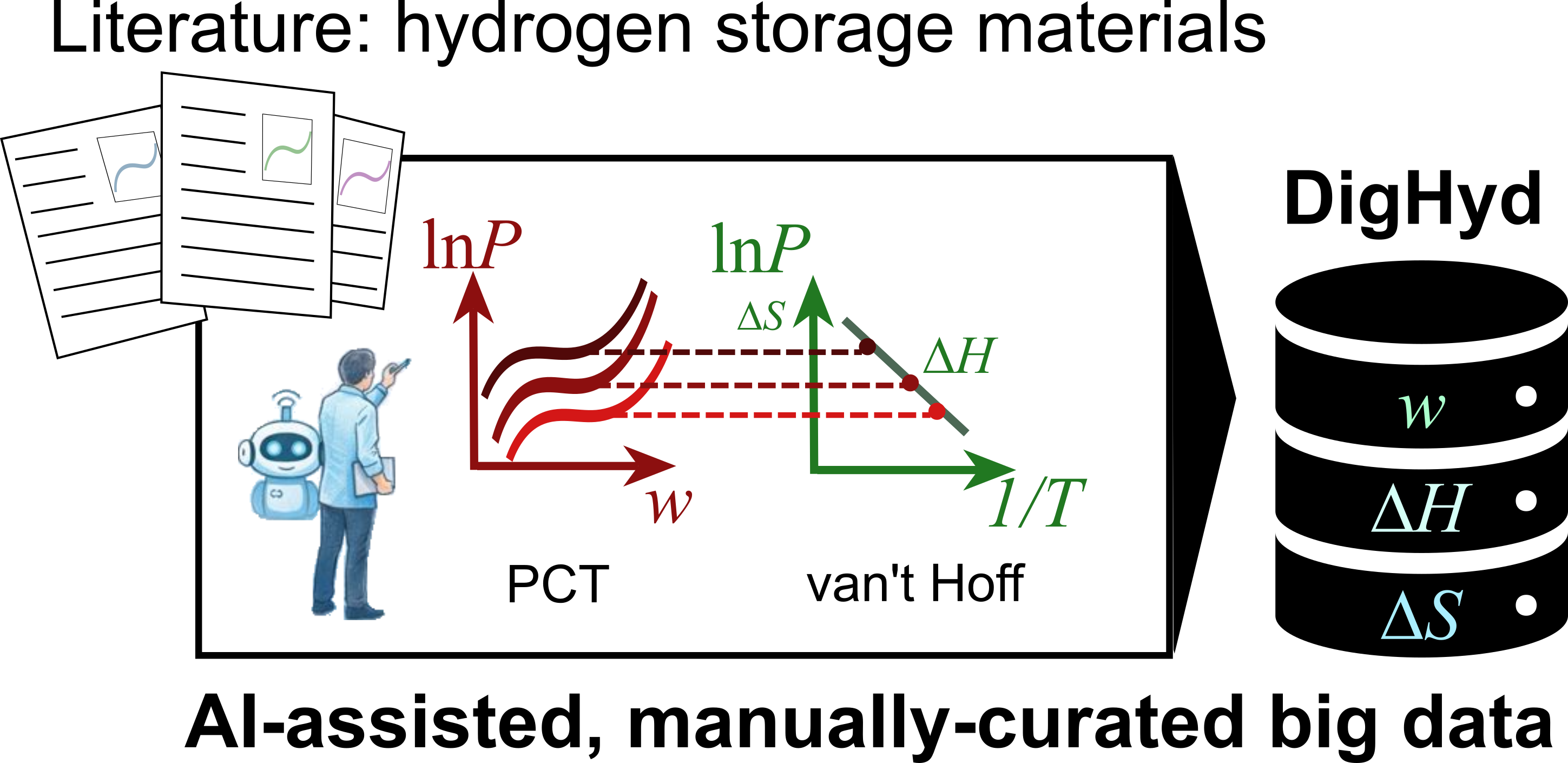
Researchers from Tohoku University and the University of Tokyo have launched the Digital Hydrogen Platform (DigHyd), a comprehensive, curated database designed to accelerate the development of hydrogen storage materials. By integrating AI-assisted literature mining with rigorous human validation, the team has compiled over 30,000 data entries from more than 4,000 experimental publications to better understand the complex relationship between storage capacity and release pressure.
Unlocking Material Relationships
The transition to a hydrogen-based economy depends on identifying materials that can efficiently store and release gas under practical conditions. However, researchers often face a trade-off: increasing a material's storage capacity can inadvertently alter the pressure required to release the hydrogen. To address this, the team used symbolic regression—an AI method that generates interpretable mathematical equations—to map how various material properties interact.
The resulting physical map reveals that while lighter host atoms generally improve storage capacity by weight, the material's mechanical properties play a critical role in equilibrium pressure. Specifically, the study found that stiffer materials resist the lattice expansion required to accommodate hydrogen, which increases the energy needed for storage and influences release conditions. By linking factors such as electronegativity, thermal conductivity, and elastic stiffness, the platform provides a framework for scientists to design materials that balance these competing physical requirements.
Future Applications
The DigHyd platform, which is now publicly available, allows researchers to trace data back to original experimental sources, ensuring transparency and reliability. Moving forward, the team plans to use these insights to synthesize and test new material candidates, bridging the gap between data-driven predictions and real-world performance. The study was published in Applied Physics A on September 4, 2026.
