
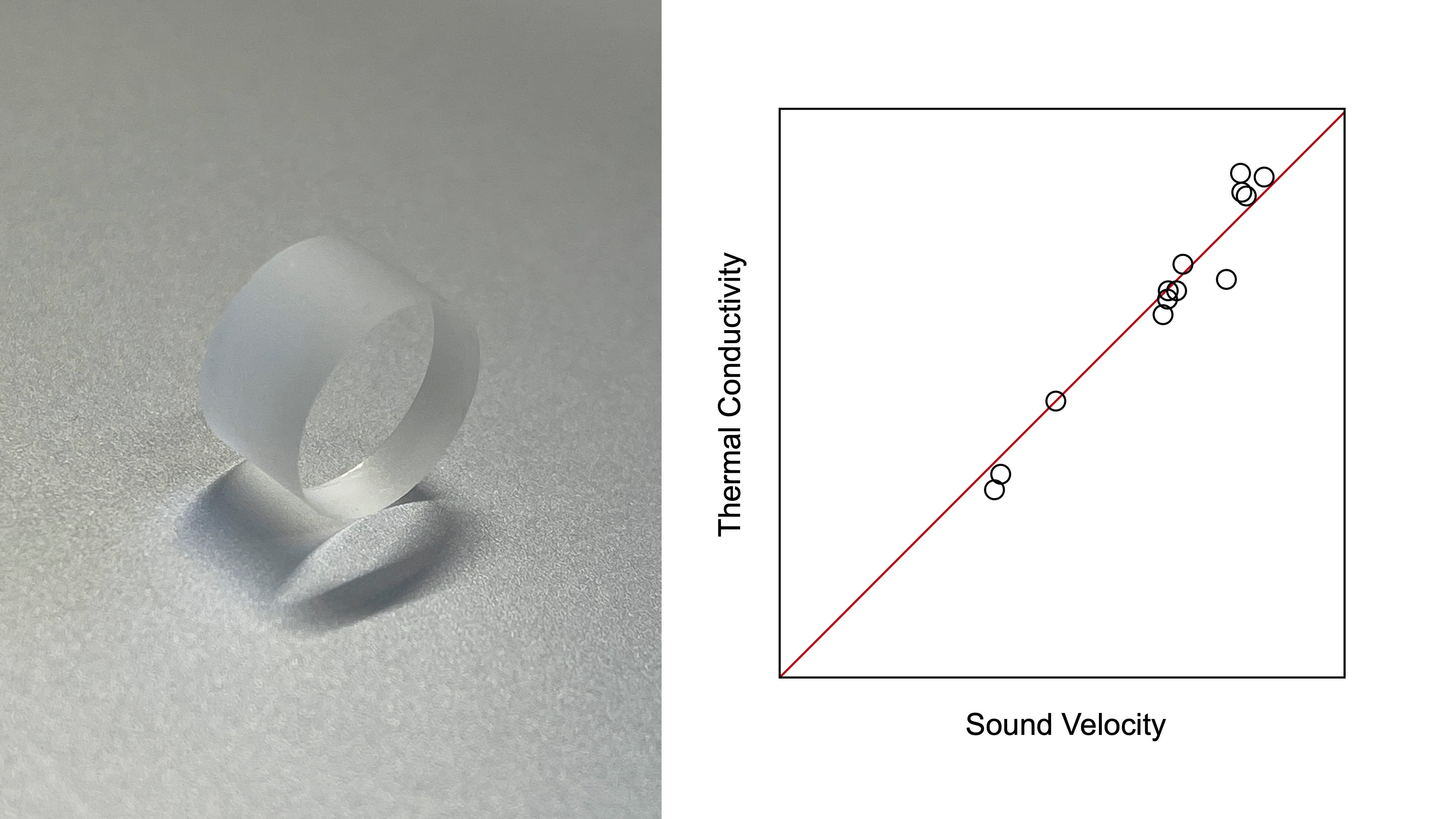
Researchers at Tohoku University have uncovered a critical factor in how heat moves through silicate glass, a discovery that could streamline the development of materials for next-generation electronics. By analyzing 13 different glass compositions, the team determined that the speed of sound within the material is the primary driver of its thermal conductivity.
Simplifying Material Design
Thermal conductivity—the ability of a material to transfer heat—is vital for the performance and reliability of modern technology, from smartphone screens to complex electronic components. While scientists have long understood that heat transfer in insulators relies on quasiparticles called phonons, the complex interplay between heat storage, phonon movement, and sound velocity remained poorly defined.
The study, published in Applied Physics Letters, revealed that while other factors like volumetric specific heat and the distance phonons travel (mean free path) exhibit a trade-off, they effectively cancel each other out. This leaves sound velocity as the dominant, predictable variable. By focusing on this single metric, engineers can now more efficiently design glass materials with specific thermal properties rather than balancing multiple independent variables.
“Our findings provide a clearer guideline for designing the thermal conductivity of glass,” said Sohei Sukenaga, an associate professor at Tohoku University. The team plans to investigate whether this relationship holds true for other material types and at varying temperatures, potentially establishing a new standard for engineering non-crystalline materials.
