
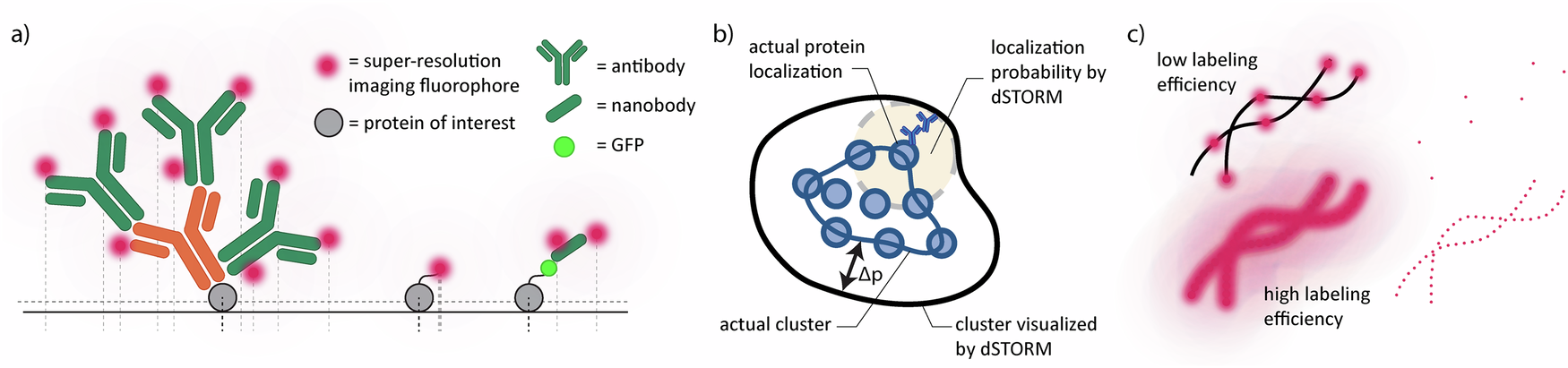
Advanced single-molecule localization microscopy (SMLM) techniques, such as Photoactivated Localization Microscopy (PALM) and direct Stochastic Optical Reconstruction Microscopy (dSTORM), enable the precise visualization of individual proteins and nanoscale structures. However, quantifying diffraction-limited protein nanoclusters remains challenging because the relative accuracy of labeling and imaging parameters has been poorly characterized.
To evaluate these labeling-induced errors, researchers combined Monte Carlo simulations with experiments using well-characterized two-dimensional focal adhesion kinase (FAK) clusters as a benchmark. The findings show that antibody-based dSTORM produced up to a roughly 42% quantification error relative to PALM. This error margin diminished when smaller probes or monovalent nanobodies were utilized.
The investigation also underscores several other critical SMLM variables that affect cluster measurements, including antibody clonality, fluorophore-to-antibody ratios, steric hindrance, and stochastic fluorophore blinking. Systematically measuring these factors establishes a clearer baseline for comparing error impacts across SMLM methodologies, aiding researchers in translating molecular localization data into accurate biological insights.
