
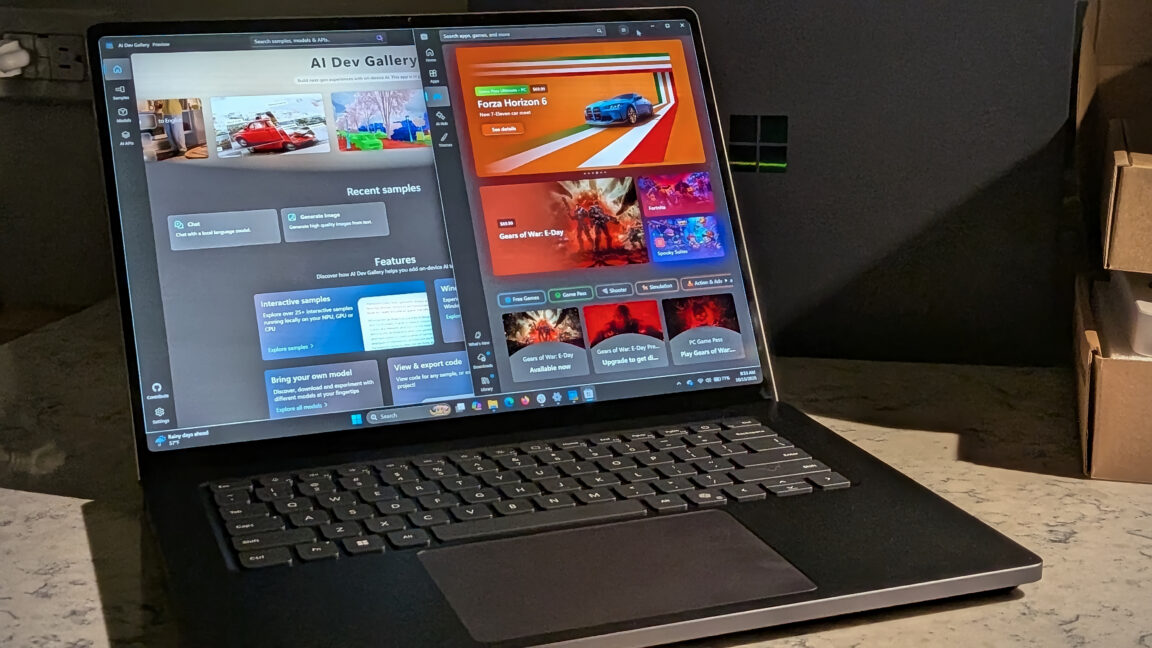
Microsoft’s new Surface Laptop Ultra aims to unify demanding development tasks, local AI processing, and high-end gaming into a single portable machine. Powered by an ARM-based Nvidia RTX Spark platform, the high-performance laptop is targeted directly at power users and would-be MacBook Pro buyers.
Priced at a premium starting at $2,599 and scaling up to $5,899 for top-tier configurations, the device enters the market amid a challenging period for personal computing hardware shipments. The base model features 24GB of unified memory and Windows 11 Home, while higher-tier models include 64GB of memory and Windows 11 Pro. Reviewers note that buyers should carefully consider memory demands, as Windows 11 and local gaming VRAM allocations can heavily tax lower-specced variants.
The hardware features a striking 15-inch mini-LED display with a 3270×2180 native resolution, offering deep blacks and a 2,000-nit peak brightness, though glossy glass can cause glare in brightly lit environments. Reviewers also praised the comfortable keyboard and large 5.5-by-3.5-inch trackpad, alongside surprisingly robust audio output for a slim chassis.
Performance testing showed the laptop capable of running complex local AI workloads—such as a 70-billion-parameter model—and handling modern AAA games at impressive speeds. However, users running games with kernel-level anti-cheat measures under Windows’ built-in Prism emulation layer may encounter warnings due to system file translation. Furthermore, certain hardware encoding options like Nvidia NVENC are currently unavailable in software like HandBrake, and full Copilot+ software features are scheduled to roll out between late 2026 and early 2027.
Battery performance held up reasonably well during mixed daily workloads, retaining 66 percent capacity after three hours of varied use, though heavy AI processing quickly drains the battery.