
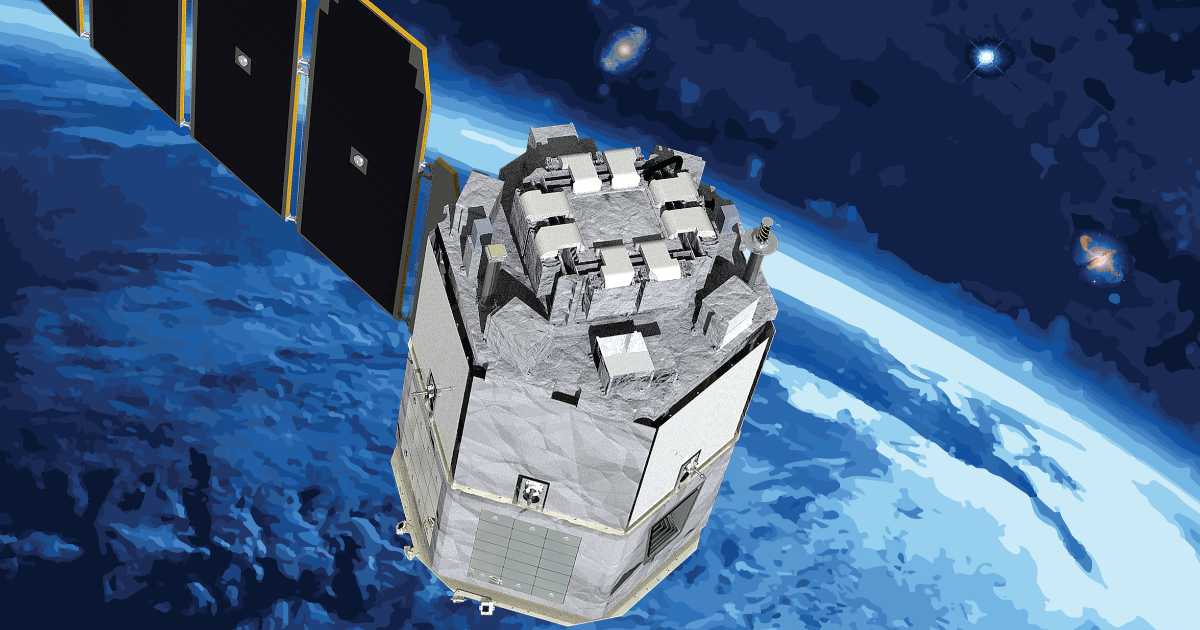
NASA’s upcoming Compton Spectrometer and Imager (COSI) mission has achieved a significant project milestone as it prepares for an orbital launch. Built to probe deep cosmic questions regarding the origins of matter in the galaxy, the $145 million gamma-ray telescope is progressing through assembly phases ahead of its scheduled departure.
Engineers are actively assembling the scientific instruments for the wide-field observatory, which recently arrived at Northrop Grumman’s satellite manufacturing facility in Sterling, Virginia. Once the payload integration onto an LEOStar-2 spacecraft is complete, the observatory will undergo thorough thermal and vibration testing to ensure it can withstand the extreme environment of a rocket launch and space operations.
Path to Orbit and Balloon Heritage
The $145 million mission is slated to launch in August 2027 aboard a SpaceX Falcon 9 rocket. Liftoff will take place from Cape Canaveral Space Force Station in Florida, supported by a firm-fixed-price launch services contract awarded to SpaceX in 2024 valued at approximately $69 million.
COSI's design is the culmination of two decades of technology development and testing aboard high-altitude scientific balloons. During a flight from May to July 2016, a balloon-borne prototype operating at 110,000 feet successfully detected and localized its first gamma-ray burst, designated GRB 160530A. Gamma-ray bursts are exceptionally powerful cosmic events that last from milliseconds to minutes, occasionally erupting with a quintillion times the brightness of our Sun.
Probing Milky Way Elements and Antimatter
Selected in 2021 as part of NASA’s Astrophysics Explorers Program from a pool of 18 proposals, COSI will target several complex phenomena:
- Chemical Origins: Mapping gamma-radiation produced by radioactive atoms from giant star eruptions to determine where elements critical to Earth's formation were created in the Milky Way.
- Antimatter Investigation: Studying the sources of the galaxy's positrons, which are positively charged subatomic antielectrons.
- Nucleosynthesis: Detecting active sites where new atomic nuclei are forged.
- Multi-Messenger Astronomy: Discovering counterparts to multi-messenger sources—such as gravitational waves and neutrinos—and detecting short-lived gamma-ray bursts to enable rapid follow-up observations by other telescopes.
By mapping these high-energy processes across the Milky Way and beyond, the COSI mission will provide vital clarity on the life cycles of stars and the creation and destruction of cosmic matter.
