
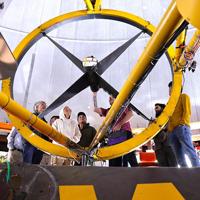
The University of Wyoming’s Wyoming Infrared Observatory (WIRO) recently marked a significant milestone, celebrating 50 years of astronomical discovery. Located on Jelm Mountain, a 55-minute drive from Laramie, the facility has served as a cornerstone for scientific research and student training since achieving "first light" in 1977.
A Legacy of Innovation and Hands-On Science
The 50th-anniversary event, held October 2 on the UW campus, brought together generations of staff, students, and faculty to reflect on the observatory's history. Organized by Professor Chip Kobulnicky, the celebration highlighted the "self-starter" culture that defined the facility’s early years. Because Gehrz and Hackwell managed the project by securing separate bids for components, the team often handled construction tasks themselves, from digging foundation trenches to building instrumentation in-house.
Presentations during the event covered both the technical achievements and the daily realities of life at the observatory. Former staff and students shared stories ranging from plumbing mishaps and office pranks to the development of advanced imaging systems. This collaborative environment proved to be a launchpad for many careers; alumni of the program have gone on to hold significant roles in the aerospace industry and at major research institutions worldwide.
Scientific Impact and Future Directions
Over its five decades, WIRO has facilitated more than $14 million in grants and contracts, resulting in over 120 scientific articles and dozens of graduate and undergraduate theses. Research conducted at the site has provided critical insights into the chemical evolution of the universe, including how nova explosions produce the building blocks of planets and life.
While WIRO is no longer the largest telescope in the world, it remains the only one owned and operated by a single university. This unique status allows it to serve as an invaluable testing ground for new instrumentation and a dedicated facility for long-term surveys. Looking ahead, faculty members like Jordan Stone are working on projects such as the Astrophotonic Spectrograph and Imager in the Near-Infrared. These initiatives aim to use WIRO to "feed the giants," helping researchers identify and verify target objects for larger, collaborative space-based observatories.
As the facility enters its next half-century, it continues to function as a vital training ground for the next generation of astronomers, offering hands-on experience that remains rare in the field. As Professor Kobulnicky noted, the observatory’s ability to provide dedicated, long-term access to the night sky ensures that Wyoming remains a competitive force in modern astronomy.
