
Betelgeuse Atmosphere Rebounds Following Great Dimming Event
New radio observations reveal that the outer atmosphere of the red supergiant star Betelgeuse has returned to normal conditions following its historic dimming event in 2019 and 2020. Located approximately 724 light-years away in the constellation Orion, the massive star is roughly 1,400 times larger than the Sun and previously underwent a dramatic surface mass ejection that caused unprecedented century-scale fading.
Between 2021 and 2026, a research team led by Dr. Lynn Matthews of the MIT Haystack Observatory utilized NSF’s Karl G. Jansky Very Large Array (VLA) and the Atacama Large Millimeter/submillimeter Array (ALMA) to image Betelgeuse across seven radio frequencies. Prior to the Great Dimming, VLA data from August 2019 captured the star's atmosphere at a three-decade low temperature. The updated VLA measurements confirm that brightness temperatures at 22 and 44 GHz have successfully rebounded to typical photospheric levels, peaking around 3,500 K.
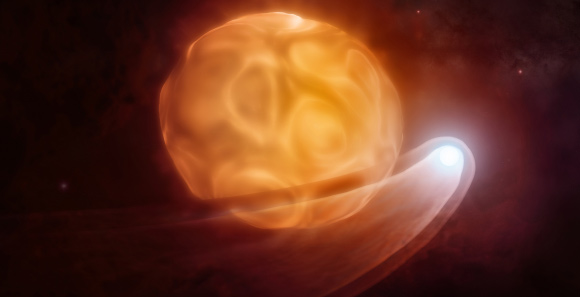
Furthermore, the study provides indirect evidence regarding Betelgeuse's recently identified companion star, Siwarha, which orbits within the red supergiant's extended atmosphere and drives a 2,100-day variability cycle. While the companion was not imaged directly, researchers tracked its gravitational footprint by analyzing the star's shape. Radio images showed that Betelgeuse's ellipticity fluctuated in correlation with the companion's predicted orbital phase, peaking when the smaller star reached its greatest apparent separation.
The findings offer fresh insight into stellar mechanics, suggesting the companion is actively shaping Betelgeuse's outer envelope where stellar winds are launched, leaving a wake-like disruption as it plows through the extended atmosphere. The study was published in the Astronomical Journal.
