
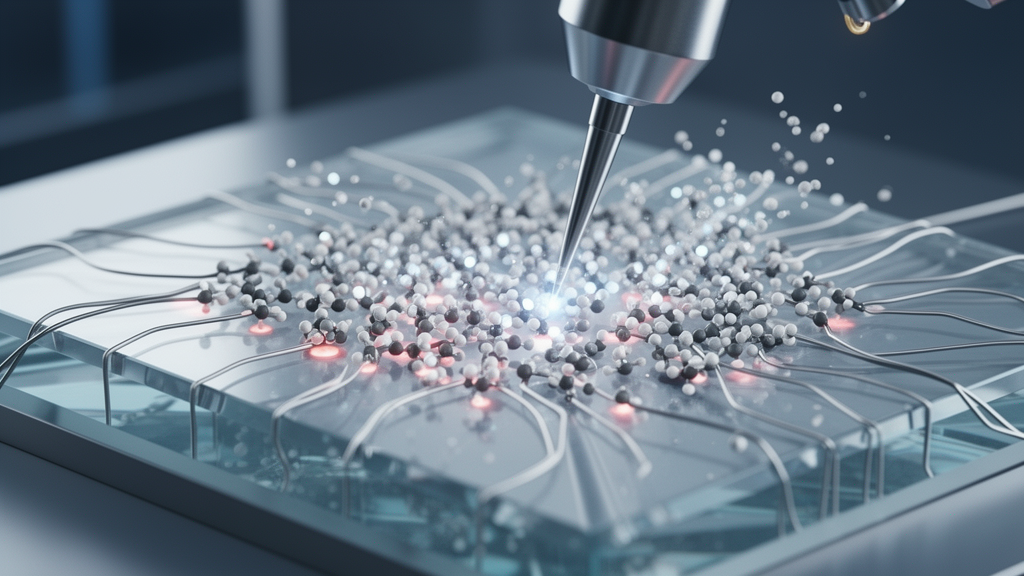
Researchers at the National University of Singapore have developed a new optical imaging method called DELINE to map individual catalytic reaction events on working material surfaces, uncovering local differences that conventional measurements typically mask.
Revealing Local Activity with DELINE
Led by Assistant Professor Mao Xianwen from the Department of Materials Science and Engineering at the NUS College of Design and Engineering, the research team used thin gold plates to examine water dissociation—a critical step in producing hydrogen from water. The method works by linking a non-fluorescent catalytic reaction to a rapid follow-up reaction involving a probe molecule that produces fluorescent signals, allowing scientists to visualize regional activity without altering the underlying material.
Trade-Offs in Catalyst Design
By mapping 195 surface regions across 39 gold plates, the researchers discovered a distinct kinetic trade-off: regions exhibiting a stronger response to applied voltage generally possessed slower baseline reaction rates at equilibrium. This relationship, known as kinetic compensation, means that a surface structure performing well under one set of electrical conditions may lose its advantage when operating parameters change.
The study also revealed that optimal surface features vary by material. While edges and side surfaces were typically more active than flat faces on gold catalysts, tests on copper showed that broad, flat faces were more active during water dissociation. Furthermore, applying DELINE to nitrate reduction demonstrated that the imaging approach can be extended beyond water splitting to other chemically useful processes.
The team can analyze roughly 100 particles within a single three-minute microscope recording, offering a high-throughput way to study surface heterogeneity. Moving forward, the researchers plan to explore new probe designs for reactions such as nitrogen fixation and visualize processes inside operating batteries to help guide future material design choices.
